Showing posts with label Airplane travel. Show all posts

Monday, March 18, 2013

Delta-- 2013 And Still The Worst Airline Since Hezarfen Ahmet Celebi Jumped Off The Galata Tower in 1638


Let me start with the end of the story. I bought a business class ticket on Lufthansa from L.A. to Florence for $3,112. There's a stop in Frankfurt coming and going. The departure and arrival times are all perfect and the wait times in Frankfurt are minimal. Two free bags in cargo and two free bags in the cabin. The plane has WiFi. The whole procedure of buying the ticket took 20 minutes, tops.

I had spent the better part of the day before that-- something like four hours, on the phone, mostly on hold, trying to buy a ticket from L.A. to Florence on Delta. I know, I know... Delta is the worst airline in the western world and only an idiot even attempts to try on it. The problem is one of my credit cards-- an American Express card that I almost never use any longer (because of Delta's affiliation) had racked up tens of thousands of miles on Delta years ago and I've never been able to use them because Delta has a policy of putting up every obstacle imaginable to prevent their customers from ever using miles. Have I mentioned that Delta is the worst airline?

Anyway, I would love to get rid of those miles... so I tried booking a ticket. My dates were flexible and, although I was trying to get to Florence, I told the agent I would be willing to fly into Rome, Milan or Pisa is nothing was available into Florence. I said I didn't mind a layover in any European city if that was necessary. I made it as easy as I could. It didn't matter. Nothing was available. OK, how about if I buy a coach ticket and I use the miles to upgrade to business? She said that she could do. OK. Hours later-- and I'm sure it was more grueling for her than it was for me, who, after all, was just sitting here writing a post about the catastrophe in Cyprus while she scoured the Delta system and the system of all Delta's partners.

Eventually she came up with a somewhat inconvenient flight for $3,400 and something (in coach, but upgradable to business for 50,000 miles). I said OK. I gave her all the info right through to the secret code of the back of my credit card. But by the time she tried to finalize the deal the price had jumped to $6,000 and something. I said, "No, let's find another flight." She made up a story that she had spent more time with me than she was allowed and that she would have to transfer me to another agent. I said OK. She didn't transfer me to anyone, just put me back in the wait line.

That's when it dawned on me that it was CHEAPER to buy a business ticket on Lufthansa (as well as half a dozen other airlines) than an upgradable coach ticket on Delta. I can't believe Delta stays in business. Really, I can't.

Saturday, February 23, 2013

What Will Political Dysfunction Do To America's $1 Trillion Annual Tourism Industry?


The Administration thinks that by next weekend the relatable face of sequestration for thousands in the middle class will be painful airport travel. Long, long lines and miserable delays and inconvenience. Republicans, the s&m party, think it's their job to add pain and suffering to people's lives.

When I was president of Reprise, a division of AOLTimeWarner, we had several sleek private jets at our disposal. I spent a lot of time in New York and in London and flying privately, rather than hassling at an airport, was deliciously convenient. In all my years at the company, though, I never ordered up one of the planes-- not once. It was just too expensive. I always thought it was just stealing from the owners (the stock holders) and that the money would be better used in breaking a new artist. Don't get me wrong... when one of my colleagues was taking the plane and invited me along, I never turned it down. I loved it. It just was never going to come out of any Reprise budget. Once 2 presidents, a chairman, a CEO and a bevy of senior vice-presidents went on a month-long tour of our European affiliates. We went to Paris, Hamburg, Milan, Madrid, Dublin and London and I think I did side trips to Amsterdam, Brussels and Stockholm. Man, there are no words to describe that kind of convenience. The ease of travel was something to marvel at. But it must have cost a fortune.

The people who have the most to say about decisions like the Sequester have their own planes. They tell Boehner and Miss McConnell what they want done. The campaign the Administration is doing to give the Sequester a dysfunctional airport face is laughable to them. Will it matter to GOP backbenchers who start hearing from business travelers?

Ray LaHood is still Secretary of Transportation and he used to be a Republican congressman from Illinois. More than half the Republicans in Congress served with him. He's warning them that this is going to be bad. Friday he predicted chaos at the nation's (public) airports, primarily because thousands of FAA employees-- including air traffic controllers-- will be furloughed to save money. 
"This is very painful for us because it involves our employees, but it's going to be very painful for the flying public," LaHood said.

"Obviously, as always, safety is our top priority and we will never allow [more than] the amount of air travel we can handle safely to take off and land, which means travelers should expect delays," he added.

"Flights to major cities like New York, Chicago and San Francisco and others could experience delays of up to 90 minutes during peak hours because we have fewer controllers on staff."

..."At [the Department of Transportation], we will need to cut nearly $1 billion, which will affect dozens of our programs," he continued.

"Over $600 million of these cuts will need to come from the Federal Aviation Administration, the agency that controls and manages our nation's skies. As a result of these cuts, the vast majority of FAA's nearly 47,000 employees will be furloughed for approximately one day per pay period until the end of the fiscal year and, in some cases, it could be as many as two days."

LaHood said the FAA has begun preparing airlines and unions about the possibility of furloughs for FAA workers. But he said the effects of the cutbacks would be felt most by airline passengers.

LaHood said members of Congress would likely receive complaints from frustrated passengers who are dealing with flight delays.

"As a former member of Congress, I heard complaints all the time from my constituents when their flights were delayed or when their flights were canceled," he said. "Nobody likes a delay. Nobody likes waiting in line. None of us do."

LaHood acknowledged that the White House was seeking to gain a political advantage on congressional Republicans with his dire warning about air travel, even as he denied the administration was using scare tactics about sequestration.

"The idea that we're just doing this to create some kind of scare tactic is nonsense," LaHood said.  "We are required to cut a billion dollars. And if more than half of our employees are at the FAA... there has to be some impact. That's the reason we're announcing what we're announcing."
Tourism is likely to be hard hit as an industry in general. The $110 million dollar cut to the national parks system won't do much to help reduce the deficit but it will mean shuttered campgrounds, shorter seasons, road closings and reduced emergency services
Great Smoky Mountains National Park will close four campgrounds. The Grand Canyon National Park will shorten visitor center hours at the South Rim. Cape Cod National Seashore in Massachusetts will close its visitors center and restrict access to large sections of the Great Beach. And Yosemite and Yellowstone will delay summer road openings up to four weeks, according to the Coalition of National Park Service Retirees, which said it obtained the details from sources in the park service.
Conservative have always opposed the national park system anyway and in recent years have advocated to selling it off piece meal. And, over the years, friends of mine who have worked served on the House Foreign Affairs Committee have told me Republicans are generally contemptuous and mistrustful of anything foreign. They don't understand the role of foreign tourism on many American cities that cater to foreign visitors, like New York, L.A., Miami, Las Vegas, El Paso, San Antonio, Honolulu. U.S. State Department Consular offices around the world are already operating with serious backlogs of unprocessed visa applications. Sequestration would force a significant increase in wait times for these documents and ports of entry would also be affected, both in terms of the waiting time for passengers to clear immigration and customs, and in terms of the parts and goods imported into American markets. The net impact of these cuts are not going to save money, thy're going to cost money... and lots of it over a long period time and rippling through the economy.


Tuesday, April 3, 2012

Are Frequent Flier Miles Worth the Trouble Anymore?


Some of my friends don't even bother collecting frequent flier miles. I used to be rabid about them. But most of the airlines-- particularly Delta-- have made them so difficult to use for anything worthwhile, that sometimes they barely matter any longer. Bottom Line published a post recently, How to Get More Mileage from Your Frequent-Flier Miles and it has some useful tips. Not earth-shattering, world-changing tips. Delta still sucks beyond belief... but useful tips.
Cashing in frequent-flier miles for the flights that you want can be devilishly difficult. Ways to overcome the barriers…

Use different airlines for different legs of the journey.

In the past, frequent-flier trips essentially had to be round-trips between two destinations on one airline or its partners-- that’s how the programs offered awards tickets. Today most airlines offer awards tickets per flight. So if you can’t find both the outbound and return awards seats you want at the frequent-flier price you want on one airline, you can search for a flight for each leg separately on two different airlines, assuming that you have enough miles on both airlines.

Add a third leg.

On some airlines, you might be able to add an extra destination without increasing the number of required frequent-flier miles. For instance, on Delta you could fly from New York City to London, then a few days later, from London to Paris on the same airline or one of its partner airlines, and then from Paris back to New York City. However, airlines are increasingly phasing out this practice.

Participate in the Southwest, JetBlue or Virgin America frequent-flier program.

These airlines do not impose limits on the number of available awards seats on a flight. Any seat that is available for cash also is available for frequent-flier miles.

There is a downside-- the number of miles required for an awards ticket increases with the cash price of the ticket. Still, participating in one of these three programs is a great way to ensure that you can get an awards ticket even to popular destinations and/or during busy travel times.

Call a reservations agent.

Airlines now impose fees for booking awards tickets over the phone-- usually around $25 per passenger for the entire trip-- but calling an agent can make sense when you’re having trouble finding the best ticket.

Good reservations agents not only know the ins and outs of the awards seat booking system, they also often have options available to them that are not available to customers through the airline’s Web site. These include cobbling together trips using partner airlines… changing planes in less obvious airports… or perhaps even unlocking seats that are not listed on the site as awards seats.

You pay nothing if the reservations agent can’t find a solution that satisfies you and you don’t book a ticket.

Book early, book late or book holiday flights.

The single best time to find an awards seat is 330 days before the flight, when these seats first enter the system. However, additional awards seats often enter the system within two weeks of departure. Awards seats also tend to be plentiful for people willing to travel on Christmas or Thanksgiving Day rather than during the week before or after.

Redeem British Airways miles on the airline’s partner, American Airlines.

British Airways (BA) now charges extremely steep fuel surcharges. A “free” round-trip flight between the US and London could cost upward of $500-- on top of the frequent-flier miles required. That includes unavoidable taxes, but it’s mostly the fuel surcharge. Many other foreign airlines charge fuel surcharges, too, though most are nowhere near as steep as those of BA. To avoid these massive surcharges, redeem BA miles for flights on American Airlines, a BA partner airline that does not impose fuel surcharges.

Thursday, March 8, 2012

TSA Body Scanners Are Dangerous-- To Us But Not To Terrorists


U.S. taxpayers have coughed up at least a billion dollars on these intrusive body scanning machines that endanger our health and don't do anything to help make us safer. Dr. Lee Rogers, a prominent California surgeon from Simi Valley who's running for Congress against the head of the Armed Services Committee, Buck McKeon, whose entire career has been predicated on spending taxpayer dollars on his cronies' expensive projects, wants the scanners banned immediately.
"Currently, there are about 250 body scanners that use X-rays placed in American airports by the Transportation Security Administration which have screened millions of passengers. Last year, a report by the Inter-Agency Committee on Radiation Safety, which includes the European Commission, the International Atomic Energy Agency, the Nuclear Energy Agency, and the World Health Organization, concluded that pregnant women and children should not be subject to the scanning, even though the radiation dose from body scanners is small. The Committee also stated that governments must justify the additional risk posed to passengers and should consider other technologies to achieve the same end without the use of radiation. Recently, the European Commission banned the use of X-ray body scanners in all European Union airports, citing the health and safety concerns.”

“The TSA’s use of these devises violates an important principle in radiation safety: humans should not be radiated unless there is some possible medical benefit. The devices used for security screening are not subject to FDA regulations for safety, unlike X-ray machines in a doctor’s office. Additionally, TSA officers are prohibited from wearing radiation dosimeter badges, as worn by healthcare workers to track their radiation exposure.”
 
“It is obvious that the use of this risky X-ray technology is the result of the culture in Washington. The manufacturer of the X-ray device is a California company called Rapiscan Systems which has more than tripled their lobbying cash in the past 5 years. The health and well being of our citizens should not be for sale.”

“As Congressman, I would work to stop the use of radiating devices for human screening that serve no medical benefit and I call on others in Congress to do the same. I would ensure that any future research on X-ray screening devices for humans meets the same ethical and safety standards that are required of medical devices emitting radiation. I would also fight to allow workers who operate X-ray machinery for baggage screening to wear radiation detector badges for their safety.”

The video above, from the blog TSA Out Of Our Pants! demonstrates the absurdity and mendacity of the TSA's insistence that the nude body scanner program is effective and necessary. "The scanners," wrote the blogger-- and engineer and frequent traveler himself, "are now effectively worthless, as anyone can beat them with virtually no effort. The TSA has been provided this video in advance of it being made public to give them an opportunity to turn off the scanners and revert to the metal detectors."

Dr. Rogers vows to introduce legislation within his first 100 days in office to force the TSA to stop using bodyscanners. We've never asked anyone to contribute to a political campaign on this blog before, but if you'd like to register your disdain for the body scanners, please consider making a contribution-- and even $5 and $10 donations help-- to Lee Rogers here at the Blue America ActBlue page.

Tuesday, December 20, 2011

Danger Lurks For Airline Passengers-- Germs Are Out To Get You


Last week Lee Rogers, a Los Angeles-based physician running for Congress, explained why he would work to ban airport x-ray body scanners. The health concerns are legitimate and powerful and the risks are imposed on us by government. There's another more immediate health risk involved with flying and this one isn't imposed by government. Today's Wall Street Journal runs through the viruses and bacteria that wait in prey for airline passengers, especially at this time of the year. And all government has done are make some toothless recommendations to the airlines-- recommendations the bottom-line oriented airlines routinely ignore.
Air travelers suffer higher rates of disease infection, research has shown. One study pegged the increased risk for catching a cold as high as 20%. And the holidays are a particularly infectious time of year, with planes packed full of families with all their presents--and all those germs.

Air that is recirculated throughout the cabin is most often blamed. But studies have shown that high-efficiency particulate air (HEPA) filters on most jets today can capture 99.97% of bacterial and virus-carrying particles. That said, when air circulation is shut down, which sometimes happens during long waits on the ground or for short periods when passengers are boarding or exiting, infections can spread like wildfire.

One well-known study in 1979 found that when a plane sat three hours with its engines off and no air circulating, 72% of the 54 people on board got sick within two days. The flu strain they had was traced to one passenger. For that reason, the Federal Aviation Administration issued an advisory in 2003 to airlines saying that passengers should be removed from planes within 30 minutes if there's no air circulation, but compliance isn't mandatory.

Much of the danger comes from the mouths, noses and hands of passengers sitting nearby. The hot zone for exposure is generally two seats beside, in front of and behind you, according to a study in July in the journal Emerging Infectious Diseases, published by the U.S. Centers for Disease Control and Prevention.

A number of factors increase the odds of bringing home a souvenir cough and runny nose. For one, the environment at 30,000 feet enables easier spread of disease. Air in airplanes is extremely dry, and viruses tend to thrive in low-humidity conditions. When mucous membranes dry out, they are far less effective at blocking infection. High altitudes can tire the body, and fatigue plays a role in making people more susceptible to catching colds, too.

Also, viruses and bacteria can live for hours on some surfaces--some viral particles have been found to be active up to a day in certain places. Tray tables can be contaminated, and seat-back pockets, which get stuffed with used tissues, soiled napkins and trash, can be particularly skuzzy. It's also difficult to know what germs are lurking in an airline's pillows and blankets.

Research has shown how easily disease can spread. Tracing influenza transmission on long-haul flights in 2009 with passengers infected with the H1N1 flu strain, Australian researchers found that 2% passengers had the disease during the flight and 5% came down within a week after landing. Coach-cabin passengers were at a 3.6% increased risk of contracting H1N1 if they sat within two rows of someone who had symptoms in-flight. That increased risk for post-flight disease doubled to 7.7% for passengers seated in a two-seat hot zone.

...[S]ome basic precautions passengers can take to keep coughs away.

Hydrate. Drinking water and keeping nasal passages moist with a saline spray can reduce your risk of infection.

Clean your hands frequently with an alcohol-based hand sanitizer. We often infect ourselves, touching mouth, nose or eyes with our own hands that have picked up something.

Use a disinfecting wipe to clean off tray tables before using.

Avoid seat-back pockets.

Open your air vent, and aim it so it passes just in front of your face. Filtered airplane air can help direct airborne contagions away from you.

Change seats if you end up near a cougher, sneezer or someone who looks feverish. That may not be possible on very full flights, but worth a try. One sneeze can produce up to 30,000 droplets that can be propelled as far as six feet.

Raise concerns with the crew if air circulation is shut off for an extended period.

Avoid airline pillows and blankets (if you find them).

...You think the plane is bad? Security checkpoints harbor a host of hazards as well, researchers say.

People get bunched up in lines, where there is plenty of coughing and sneezing. Shoes are removed and placed with other belongings into plastic security bins, which typically don't get cleaned after they go through the scanner.

A National Academy of Sciences panel is six months into a two-year study that is taking samples at airport areas to try to pinpoint opportunities for infection.

With limited resources, airports and airlines have asked researchers to help figure out where best to target prevention, said Dr. Mark Gendreau of Boston's Lahey Clinic Medical Center who is on the panel.

Check-in kiosks and baggage areas are other prime suspects in addition to security lines, he said.

Thursday, December 15, 2011

Ever Wonder What Medical Doctors Have To Say About Airport X-Ray Body Scanners?


Dr. Lee Rogers is the Simi Valley surgeon running for the L.A.-area House seat which GOP fossil Buck McKeon is still clinging to. Although his campaign has focused like a laser beam on the economy, jobs and housing, it's always fascinating when he gets into topics that sit at the intersection of politics and medicine. This week his campaign called for a ban on airport body scans.
"Currently, there are about 250 body scanners that use X-rays placed in American airports by the Transportation Security Administration which have screened millions of passengers. Last year, a report by the Inter-Agency Committee on Radiation Safety, which includes the European Commission, the International Atomic Energy Agency, the Nuclear Energy Agency, and the World Health Organization, concluded that pregnant women and children should not be subject to the scanning, even though the radiation dose from body scanners is small. The Committee also stated that governments must justify the additional risk posed to passengers and should consider other technologies to achieve the same end without the use of radiation. Recently, the European Commission banned the use of X-ray body scanners in all European Union airports, citing the health and safety concerns.”

“The TSA’s use of these devises violates an important principle in radiation safety: humans should not be radiated unless there is some possible medical benefit. The devices used for security screening are not subject to FDA regulations for safety, unlike X-ray machines in a doctor’s office. Additionally, TSA officers are prohibited from wearing radiation dosimeter badges, as worn by healthcare workers to track their radiation exposure.”
 
“It is obvious that the use of this risky X-ray technology is the result of the culture in Washington. The manufacturer of the X-ray device is a California company called Rapiscan Systems which has more than tripled their lobbying cash in the past 5 years. The health and well being of our citizens should not be for sale.”

“As Congressman, I would work to stop the use of radiating devices for human screening that serve no medical benefit and I call on others in Congress to do the same. I would ensure that any future research on X-ray screening devices for humans meets the same ethical and safety standards that are required of medical devices emitting radiation. I would also fight to allow workers who operate X-ray machinery for baggage screening to wear radiation detector badges for their safety.”

Tuesday, November 29, 2011

I Hope You Used Up All Those American Frequent Flier Miles-- I Wish I Had


AMR filed for bankruptcy early this morning in New York City. Their Frequent Flier miles are now what is called "a general unsecured claim" and it's far from certain that they'll be useable. Or maybe they'll make a deal-- like a million miles for an upgrade to business class or an extra checked bag-- maybe even a roundtrip on a day you don't want to fly to a destination you would never want to go. Rothschild, Inc., one of the sleaziest and most predatory Wall Street financial firms anywhere in the world is their financial advisor. Rothschild specializes in advising their clients how to screw everyone, especially consumers. From their press release:
"But as we have made clear with increasing urgency in recent weeks, we must address our cost structure, including labor costs, to enable us to capitalize on these foundational strengths and secure our future. Our very substantial cost disadvantage compared to our larger competitors, all of which restructured their costs and debt through Chapter 11, has become increasingly untenable given the accelerating impact of global economic uncertainty and resulting revenue instability, volatile and rising fuel prices, and intensifying competitive challenges.

"Our Board decided that it was necessary to take this step now to restore the Company's profitability, operating flexibility, and financial strength. We are committed to working as quickly and efficiently as possible to appropriately restructure American so that it can emerge from Chapter 11 well-positioned to assure the Company's long term viability and its ability to compete effectively in the marketplace," Horton stated.

Sounds like the first target will be the airline's labor unions. Bloomberg reminds us that American was the last major airline in the United States to resist filing for Chapter 11 in an effort to shed contracts, a move that analysts said left it less nimble than many of its competitors. They had to sit out "a round of mergers that dropped it from the world’s largest airline to No. 3 in the U.S."

They'll be operating normally and they claim that they'll honor all Frequent Flier miles. Board chair Gerard Arpey is retiring and Thomas Horton has been named new chairman and chief executive. Last year American was the only major carrier not to turn a profit and looks like it will announce losing numbers for 2011 as well.

Wednesday, August 10, 2011

Delta Threatens To Leave U.S.


Oh boy... 2,000 extra bonus points from Delta, the airline that doesn't let their customers use frequent flier miles! The above ad came as an e-mail yesterday, the same day Delta threatened to follow Blackwater, Halliburton and other extreme right-wing companies out of the U.S. Richard Anderson, who's personally donated tens of thousands of dollars to right-wing politicians-- including heavy contributions to Boehner, McConnell, Romney, McCain and deranged nihilistic teabaggers like Tim Walberg (R-MI), Paul Gosar (R-AZ), John Bircher Paul Broun (R-GA) and Taliban Dan Webster (R-FL)-- told a crackpot Fox propagandist, Neil Cavuto, that he might pick up his toys (Delta) and leave Atlanta (and the U.S.) if he isn't free to keep up his anti-union policies.

Anderson is grumpy because of a change in labor policy that makes it easier for union organizers to win elections.


To understand what's changed you need to know that in the past, when employees were presented with the option of joining a union it wasn't just the "yes" votes and the "no" votes that were counted. The number of people who did not vote was tallied too and those non-votes were considered "no" votes. The philosophy behind this somewhat odd practice is to make sure that a majority of all employees vote for the change, giving a voice even to those workers who don't want one enough to actually cast a vote. 


...Certainly Delta is not alone in opposing anything that will increase the likelihood of unionizing. Fed Ex and UPS are also said to be lobbying hard to overturn the new National Mediation Board policy on union elections. 


But it's only Delta's top dog who decided to go on national television and threaten the nation with its exodus.


"Capital is mobile" Anderson said in a not-at-all-veiled threat that if Congress comes down on the wrong side of the unionization policy, companies will pack up and move, repeating the threat three times. 


Where might unhappy companies like his go you might ask? Anderson cites appreciatively the locomotive-like economies in Brazil and China. Now if Delta is planning to pull up stakes from Atlanta, its home for the last 70 years and carry its kit and kaboodle down to Rio or Shanghai that's news! Unfortunately, and Mr. Anderson surely knows this, a raft of restrictions would have to be changed for a US airline to makes its headquarters anywhere outside of the USA.


Delta's employees are generally so dispirited that the company's service is miserable and Delta is widely considered the worst airline in America. Dozens of groups are boycotting it for dozens of different reasons. Survey after survey show that they rank at the bottom of the heap in everything travelers care about-- and since Anderson took over and made Delta a vehicle for his neo-fascist political agenda, the airline has gotten noticeably worse.

Wednesday, July 27, 2011

Delta Sinks To New Levels Of Passenger Rip-Off


As usual, Delta won the dubious honor this year of being this blog's Worst Overall Airline... again. They really just suck on every level. Turns out the service is so bad because upper management is such a bunch of greed-obsessed reactionaries. Today's Atlanta Journal-Constitution went on and one about how that city's biggest carrier pulled a fast one on its customers after the right-wing ideologues in Congress shut down the FAA. The shutdown keeps the FAA from collecting about $200 million a week in ticket taxes. But instead of letting that accrue to fliers, Delta gobbled it up itself by increasing the base fares it charges.
Airlines have complained for years that taxes added to ticket prices drive up the cost of travel. But when those tax collections stopped last weekend and airlines had a rare chance to give fliers a break, most opted to keep prices the same and pocket the difference.

“It just seems like it was the perfect chance for the airlines to throw a bone in consumer satisfaction,” said FareCompare.com CEO Rick Seaney.

“Consumers feel like they’ve been nickel-and-dimed in the past, (and) this is a windfall that wasn’t expected... “Why wouldn’t [airlines] give consumers at least half the benefit?” Seaney said.

The suspended taxes include a 7.5 percent excise tax, a $3.70 tax per flight segment and other taxes for international flights.

As the partial shutdown continued this week, some public officials have criticized the airlines’ decision, and two U.S. senators wrote a letter of complaint to Delta’s chief executive, who also is chairman of a major airline lobbying group.

Delta, as always, started whining about the high price of jet fuel. They little windfall at customers expense amounts to between $4 and $5 million a day. In the U.S. Senate, Jay Rockefeller (D-WV) lashed out at their greed:
I wish I understood why the policy objections of one company-Delta Air Lines-mattered more than the livelihoods of thousands of people. Last year, the CEO of Delta made $9 million. Delta paid its top executives almost $20 million. Yet, it is fighting to make sure its employees cannot organize for fear that they may secure a few extra dollars in their paychecks. At the same time it is pushing for special interest provisions in the FAA bill, Delta announced it was abandoning air service to 26 small rural communities-leaving many of them without air service.

Delta then had the gall to announce publicly it would seek EAS subsidies to continue this service.  Maybe Mr. Anderson and his colleagues could forgo some of their salary to help subsidize this air service. Maybe they could use some of the millions of dollars they are collecting in a tax holiday windfall to pay for this service. Their actions are shameful.

Let me be clear, House Republicans and their Senate allies have thrown nearly four thousand FAA employees out of work, stopped critical airport safety projects, hurt hundreds of small businesses, and gutted the Aviation Trust Fund, all so that Delta Air Lines doesn't have to allow its employees to organize in a fair and timely manner.

The needs of one company should not dictate the safety and soundness of our aviation system. We need to pass a clean extension that will get people back to work, and businesses and their employees back to work building out critical airport infrastructure.

Friday, June 24, 2011

Kathmandu Essentials: Flying, Breathing, Eating

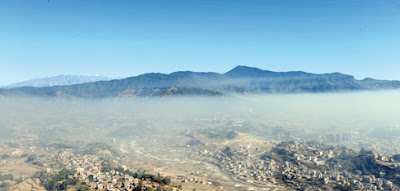
Look really hard and maybe you'll catch a glimpse of Kathmandu

Did you think I was exaggerating the other day when I mentioned Kathmandu's air is the most polluted of any big city on earth and that it's dangerous to go out without a carbon-filter mask? See that photo above? When I first started visiting Nepal in 1971, you could actually see the Shangri-La-like city from the ridge of mountains that sound it. Now you're just as likely to see... filthy air.

And it turns out that it's even dangerous to fly in the soupy mess. The top story in today's English-language newspaper, Republica is ominously entitled "Smoggy Skies Threaten Aviation in Kathmandu."
Many times, environmental issues are sidelined with the assumption that its consequences will be gradual and hence can be dealt with in the future. The question is, how long though?

“We could’ve been killed in that flight. The air pollution in Kathmandu has gotten so bad that if people don’t act now, we’re putting lives in danger here,” Kevin A. Rushing, the former USAID Mission Director to Nepal, commented in a recent conference.

“Just when our plane was about to land in Kathmandu, due to thick smog over the Valley, we couldn’t see the runway, we couldn’t see anything.

The plane then had to divert all the way around, reroute and keep flying in such a condition despite the turbulence risking the lives of all people on board.” He added, “If things don’t improve, you’d really think twice about flying to Kathmandu.”

Captain Vijay Lama, a pilot with Nepal Airlines who has been flying for more than two decades, says that Rushing’s anxiety is valid.

“The flying conditions in Kathmandu have become terrible, especially during winter”, he says. “In winter, when fog combines with smoke and other pollutants in the air, the resulting smog worsens the visibility, and it’s far worse than when it’s foggy.”

According to Lama, the rising pollution can have drastic effects on visibility on both land and in air. “There’s an increase in the number of flights being backlogged, and there are always delays after delays.

It’s all because of the smog and haze condition,” he says. “As the smog is heavier, it settles in lower altitude, and with the amount of smoke and dust particles that adds on with the moisture in the air, it becomes denser, making it impossible to fly.”

Whereas smog is mostly formed in the winter due to the mixture of smoke and fog, haze often occurs in pre-monsoon seasons that have relatively dry air, combining with the smoke and dust or particulate matters or total suspended particles (TSPs) in the air.

The chemicals which contribute to formation of smog also include harmful man-made and naturally occurring compounds, such as sulfur dioxide, carbon dioxide, carbon monoxide, nitrogen oxide, and ozone.

As reported by the US Environmental Protection Agency (EPA), when these components of smog mix up, they can create dust clouds, black soot and gray fog. This can result in a smog cloud that can reduce visibility by 70 percent.

Captain Lama stresses that if the situation in the Kathmandu Valley isn’t addressed soon, the flying conditions will just get worse, and with the risks involved, the future of aviation in Nepal could be very bleak.

According to the 2006 report “Urban Air Quality Management Strategy in Kathmandu Valley” by Jitendra J. Shah and Tanvi Nagpal, atmospheric visibility data from Kathmandu’s airport, analyzed onwards from 1970, show that there’s been a very substantial decrease in the visibility in the Valley since about 1980.

The number of days with good visibility around noon has decreased in the winter months from more than 25 days per month in the 1970s to about five days per month in 1992/93.

“Visibility is the measure of the distance at which an object or light can be clearly distinguished or seen. In aviation, it can differ with the aircraft type,” says Mishri Lal Mandal, Deputy Director of Air Traffic Services (ATS) Division of Tribhuvan International Airport Civil Aviation Office (TIACAO).

Basically, for Visual Flight Rules (VFR) or visually aided flights, the minimum visibility to be maintained is 5km.

This means the pilot has to be able to clearly distinguish an object as far as five kilometers away with his eyes whereas for Instrument Flight Rules (IFR) or instrument aided flights, pilots can fly even with the visibility is 800 meters while taking off and 1,600m for landing, he informs.

As helicopters in Nepal only operate with VFR, it’s more risky for helicopter pilots, according to Captain Nischal KC, helicopter pilot at Air Dynasty.

“When there’s haze or smog, it gets very difficult for pilots not just in terms of visibility but they also get disoriented and nauseous at times,” says KC “As helicopter pilots don’t have an instrument landing aid, we have to fly by considering the artificial horizon, and a lot of experience is required.”

KC adds that it’s the reason why during pre-monsoons and winters, when haze and smog problems are at its peak, new pilots aren’t allowed to fly without experienced co-pilots.

Ratish Chandra Lal Suman, General Manager of TIACAO, says, “Instrument flights for the Kathmandu Valley are more complicated with its hilly terrains. (So) We’re planning to bring Required Navigation Performance Authorization Required (RNPAR) technology that can help flights operate even in poor visibility as it operates through satellite signals and follows a specific path and reduces pilot workload.”

Suman shares that the increasing trends in poor visibility conditions result in flights being diverted or stranded. Then, as soon as the conditions become favorable, flights start piling up, and there’s more load than the capacity of the terminal building.

"Safety is our first concern. So we don’t authorize any flight to operate in poor visibility," says Suman. "Besides that, we also lose out on a lot of revenue when flights have to be cancelled, diverted or rerouted due to poor visibility."

KC, however, points out that flights and helicopters are also given the go ahead if there’s a visibility of more than 1,000m. From then on, it’s the pilot’s decision whether to fly or not.

In the article "Are Nepali Skies Safe?" by Amish Raj Mulmi and published in the Kathmandu Post in August 2010, Lama also mentioned that there is pressure for pilots to fly no matter what the weather condition or visibility is like. And the pressure came from everywhere-- political leaders getting late for a meeting, to airline operators losing out on revenues.

...As air pollution in Kathmandu worsens and its skies become obscure with layers of haze and smog looming in its atmosphere, nothing is being done to assure the safety of the thousands of passengers flying in and out of there everyday. Civil aviation remains at risk, and if these conditions remain unchanged, it can only get worse.

Health impacts, Dr Arjun Karki, Chest Specialist at Patan Hospital, says that the primary effects due to smog or haze would obviously be on respiratory health.

"Lung diseases can become chronic, proportionate to the concentration and density of smog," he says. "And if the gases present in the smog comprise specific toxins, the harm could be even greater."

According to Karki, on one hand, smog and haze can aggravate the health of people who already have respiratory problems, like asthma, it can also trigger lung disease in healthy people as well.

"Besides, it also depends on the length of exposure," he says. "Besides respiratory health problems, it can also cause eye irritation for some people."

However, Dr Mukunda Prasad Kafle, physician and Lecturer at the Teaching Hospital, says that while the unhealthy effects of smog or haze in particular can be many, not enough studies in this regard have been conducted here.

"As smog and haze come under air pollution, we can deduce that the health problems are similar to the ones caused by air pollution, like lung diseases and other respiratory problems. And smog can have its own adverse effects as well."

Safe to fly into Nepal? Not anymore safe than breathing the air when you get here. And this week, the tarmac at Tribhuvan International Airport buckled, "developed" potholes, and collapsed, delaying all international and domestic flights to and from and within the country for at least three hours. There seems to be a consensus that the board of Nepal Airlines is responsible.

Lucknow's nearby & Kathmandu's Kakori offers fabulous Awadhi cuisine

Now what about the restaurants? Nepal isn't a culinary destination. The best that can be said about the restaurants in Kathmandu is that they're pretty good... for Kathmandu. The acclaimed tourist spots in the tourist ghetto of Thamel are universally mediocre, although some are rated less mediocre than others. But there's no reason to ever visit one twice, unless you're just looking for fuel for your body. There were three stand-outs and I'll leave the best for last, since it's the only restaurant in the country that's actually good, not just "good for Kathmandu.

We had dinner twice in what used to be the best Indian restaurant in town, Ghar-e-Kabab in the Hotel de l'Annapurna on Durbar Marg (Kathmandu's sad version of 5th Avenue). It's relatively fancy and formal although, by our Western standards, pretty inexpensive for a quality meal. Like all restaurants we visited, around half the menu catered to vegetarians and they're very aware that most westerners are afraid of spices. If you tell them you like it spicy, they give you a normal Indian meal.

We also ate in a few of the tourist-only Nepali restaurants that serve authenticish Newari food (surprisingly decent with music and dancing). The best one was Bhojan Griha on Dilli Bazaar, a medium walk from Durbar Marg. It's in an historic old house and the hospitality is wonderful. The set meals are fine and they offer an à la carte menu as well. We found the food much better than in Thamel House, an old hippie standard, or the newer Utsav, which-- at least the night we were there-- seems to cater primarily to tourists from China.

Now, the one world-class actually excellent restaurant in the whole city is Kakori, an Indian restaurant in the Soaltee Crowne Plaza Hotel, far the hell away from anywhere else in town-- a 200 rupee taxi ride (less than $3). It was briefly called the Bukhara, having been developed and run by the folks from the restaurant of the same name in New Delhi's Sheraton, probably the best high-end restaurant in India. I reviewed it when I ate there in 2007. Kakori serves Awadhi cuisine (from Lucknow) and the restaurant's menu was developed by Nawab Sayed Nazir Haider Kazmi, grandson of Great Nawab Mir Wazir Ali Kazmi of Kakori, Uttar Pradesh's princely family. We had as good a dinner as we would have had in a fine Indian restaurant in India or London and at a fraction of the price, though expensive by Nepal's standards. And if you read my review of the ultra-rich dahl they serve in the Bukhara in Delhi... yes, it's pretty much the same-- not exactly but at least just as good.

We're staying at the Yak & Yeti and their signature restaurant, The Chimney-- which I remember as Boris'-- serves Russian and "continental" cuisine. The menu didn't appeal to us and we passed it up this time around. My tip: acclimate yourself to the fact that Nepal has other traits than great cuisine (or air) to recommend itself and... bring some of your favorite bars with you as a backup.


UPDATE: Tourist Plane Crashes Near Kathmandu

Both times I went to get a look at the Himalayas, I walked. This last time, we noticed there were flights-- really expensive ones-- that take a couple dozen tourists for a ride around Mount Everest. One of them crashed today, killing everyone on board.
A plane carrying tourists to view Mount Everest crashed while attempting to land in dense fog in Nepal on Sunday, police and eyewitnesses said. A witness said 18 bodies were pulled out of the wreckage of the plane, which was carrying 19 people.

The Beechcraft-made plane belonging to Buddha Air was carrying 16 foreign tourists and three crew members and crashed in Bisankunarayan village, just a few miles (kilometers) south of the capital, Katmandu.

...An eyewitness, Haribol Poudel, told Avenues Television that the plane had hit the roof of a house in the village and that 18 bodies were pulled out. He said a man who appeared to have survived was taken to a hospital.

Poudel said it was foggy, and that visibility was very low in the mountainous area... The plane had taken the tourists to view Mount Everest and other high peaks and was returning to Katmandu. The “mountain flight” takes tourists over the Everest region, and passengers can view some of the world’s highest peaks from the airplane windows.

Most of the tourists on board were Indian-- most tourists in Kathmandu are from India-- but there were two Americans on board as well.

Friday, June 3, 2011

Delta Airlines-- Still The Worst Carrier In The Skies... But Even More So


Delta has been the #1 worst U.S. airline every year in a row since the founding of this blog-- and that's just based on their service. Turns out, though, there's more to Delta's unsuitability as a reliable travel partner than how badly the management runs their operations. As yesterday's Wall Street Journal pointed out, the airline is a bastion of right-wing anti-worker extremism. No wonder their employees always seem so down in the dumps and resentful! The National Mediation Board is now investigating charges by flight attendants that Delta, the only non-Union U.S. airline, illegally interfered in unionization elections by pressuring employees to vote against the unions. As Joe Sudbay observed at AmericaBlog yesterday, "Delta is like the Scott Walker of airlines. It wants to be known as anti-worker."

We can probably expect even more skullduggery from Delta in the coming weeks as they double down in their anti-union jihad. They've been a lead driver in pushing Republican extremists in the House to rescind fair election rules for air/rail workers for elections conducted under the National Mediation Board. For progressives who care about keeping elections fair, giving workers the choice whether or not they want to join a union, and supporting companies who operate under basic standards of decency, there are a number of reasons for progressives to be outraged about Delta Airlines:

•  Open advocacy against fair American elections:  Delta issued a press release commending the news that Darrell Issa's deranged Committee on Oversight and Government Reform will investigate the NMB’s 2010 decision to conduct union elections for air/rail workers the same as all other types of American elections. Mike Campbell, Delta’s executive vice president of H.R. and Labor Relations said, "This investigation is an important victory for Delta people because it will finally allow the facts to speak for themselves.” Unfortunately for Delta, the facts aren’t on their side-- there’s no reason to conduct NMB elections differently from every other form of election, union or non-union, in the nation. If congressional and Senate elections were conducted under such rules, in which non-participating eligible voters were counted as having voted, then zero Members of Congress would have won their last election.

• Bumping paying customers…so Delta employees can lobby:  Delta is so committed to its anti-union ideology that it offered its employees the chance to travel to Washington to lobby against fair union elections under a provision that may bump paying customers. Talking Points Memo reported that the group No Way AFA, “a coalition of Delta employees who want to deliberalize union rights,” came to Washington the week of the House vote on the FAA Reauthorization bill to lobby against fair election standards... and potentially bumping paying Delta customers in the process. According to the article, “A Delta spokesperson said No Way AFA operates separately from the company itself, but that the company "allow[s] employees to travel positive space to D.C. when supporting legislative efforts that the company supports.”  According to TPM, this means that “the "positive space" fly-in could squeeze out seating space for regular travelers.”

• Free upgrades and lining the pockets of policymaker friends:  An investigative journalism piece in Georgia recently found that leading Republican lawmakers in Georgia’s state legislature received free upgrades from Delta to platinum status, valued at approximately $10,000 to $15,000 per year. Valued as campaign contributions, the piece noted that Delta low-balled the reported value of the platinum upgrades in state ethics records. Unsurprisingly, Delta has a long history of being generous to lawmakers like Rep. John Mica, who have voted the right way in Delta’s eyes by seeking to return NMB union elections to the old, undemocratic rules.

I've long been going out of my way to look for alternatives to flying on Delta just because of the lousy service and their refusal to let people use frequent flier miles, but now I can see there are even more reasons to avoid the worst airline in the skies.


Saturday, May 21, 2011

Preparing For Nepal-- What About The National Carrier?

Akash Bhairab-- the 2 boys are fine; the 2 goats... not so much

We've flown-- reluctantly-- on Royal Air Nepal in the past. And we're about to again-- although the name has been changed, with the abolition of the monarchy to Nepal Airlines. Roland panics; I'm fatalistic. There hasn't been a fatal crash in a decade. But this morning he sent me some old news reports. The one he was the most worked up over had to do with the head honcho at the airline being jailed for corruption. The only part that surprised me is that he was jailed. In Asia you really have to assume that everyone is corrupt-- and pray that its under control and that, for example, he isn't pocketing the money that's supposed to go for engineer maintenance.

I was more interested in live goat sacrifice to Akash Bhairab, the Hindu god of sky protection.
Officials at Nepal Airlines (formerly known as Royal Nepal Airlines), Nepal’s state-run airline, have sacrificed two goats last week to appease Akash Bhairab, the Hindu sky god (who is actually painted on the fuselage of the aircraft), following a long series of technical problems with one of their Boeing 757 airliners due to which Nepal Airlines has had to suspend some services in recent weeks (it was probably a noticeable part of their international services as it is one of only two mid-haul aircrafts at the airline – the domestic market is served by seven Twin Otters).

The goats were sacrificed in front of the troublesome aircraft on Sunday at Nepal’s international airport in Kathmandu in accordance with Hindu traditions, an official said. They hope that after this sacrifice there will be no more (or not as many) technical problems to be fixed with this particular aircraft, and thus there will be less interruptions to their operations due to aircraft maintenance. ”The snag in the plane has now been fixed and the aircraft has resumed its flights,” said Raju K.C., a senior airline official, without explaining what the problem had been. Local media last week blamed the company’s woes on an electrical fault. The carrier runs international flights to five cities in Asia, and this particular flight arrived to Hong Kong safely after the ritual. It is common in Nepal to sacrifice animals such as goats and buffaloes to appease different Hindu deities.


UPDATE: And If That's Not Enough... How About A Maoist Revolution To Interrupt Your Holiday Plans?

Always worrying, that Roland. This morning he wasn't thinking about airline maintenance but revolutions and sent me this pleasant news from the Times of India about political trouble brewing again in Nepal... as I rush to do all my last minute preparations for the trip.
Last year, as Nepal's Communist-Congress ruling alliance failed to draft a new constitution within the stipulated deadline and sought more time, the main opposition Maoist party paralysed the republic for six days, calling a general strike to pressure the then prime minister Madhav Kumar Nepal into resigning.

One year later, the turbulent republic continued to suffer as cruel history repeated itself. This time, it was the Nepali Congress, booted out of the alliance by new communist PM Jhala Nath Khanal and sitting in opposition that flexed its muscles in the capital on Friday, holding a mass meeting where its top leaders demanded the resignation of Khanal.

"We are here with 10 demands," said Nepali Congress prime ministerial candidate and former deputy prime minister Ram Chandra Poudel. "No party will be allowed to play the politics of arms. The Maoists have to surrender their arms and give up their fighters. Nepal's king Birendra was wiped out along with his family because they made themselves above law. The Maoist army cantonments have also put themselves above law and that is bound to lead to catastrophe."

They may be backing away from the brink... a little. I sure hope so. We'll be there soon. Communists vs Maoists-- so strange.

Friday, May 13, 2011

Best And Worst U.S. Airlines-- Short Version: They're All Pretty Bad These Days


The June issue of Consumer Reports rates the best and worst U.S. airlines. The best news didn't have anything to do with the sorry state of the collapsing airline industry itself but with the fact that the Department of Transportation announced a series of very minimal protections for consumers in April, including:
• Disclosing fares and fees. Airlines and other ticket sellers will be required to disclose all fees, including baggage charges. All fees and taxes must be included in advertising.

• Refunding baggage fees. Airlines will be required to refund those fees if your bags are lost.

• Extending tarmac delay rules. The DOT's 2009 ruling on extended tarmac delays is being strengthened and expanded. The current regulation requires domestic flights to return to the gate after three hours, and passengers must be provided with adequate food, water, working lavatories, and medical treatment. This rule will now include U.S. carriers operating international flights, as well as foreign airlines operating out of U.S. airports.

• Compensation for bumping. If you are involuntarily bumped from a flight, new regs will provide increased compensation, in some cases doubling the current amounts.

• Limiting fare increases. Airlines will not be allowed to raise your fare after you’ve purchased your ticket.

All stuff we used to take for granted... used to. Anyway, the Consumer Reporters survey included almost 15,000 readers and they were not kind. Eight of the ten airlines rated received low scores for seating comfort-- exceptions being JetBlue and, incongruously, since their seating sucks, Southwest. These two airlines also topped the overall list.
Other quality-of-flight measures also got low marks from our readers, including cabin-crew service, cleanliness, and in-flight entertainment. The proliferation of added fees further contributes to passengers' low opinion of today's flying experience, and even to their decision of whether to fly at all, as we explain in Carriers continue to squeeze with fees.

But some carriers have done a better job than others, as evidenced by a wide difference in overall satisfaction scores, from Southwest's lofty 87 to US Airways' lowly 61. Southwest was the only airline to receive top marks for check-in ease and the service provided by its cabin crews. Passengers also gave the airline high grades for cabin cleanliness and baggage handling. The latter might reflect the fact that Southwest is the only airline we rated that lets you check two bags free of charge. But bags three, four, and beyond will cost you $50 each. And like most other carriers, Southwest charges extra for items over its size and weight limits. (Our survey was conducted before Southwest's well-publicized problems this past April with cracks in several of its planes.)

JetBlue, which ranked second in overall satisfaction, was the only airline to outscore Southwest for seating comfort, possibly because it gives passengers more room than they're accustomed to in this era of tightly packed planes. JetBlue's coach seats are 32 to 38 inches from the seat directly ahead, while coach seats on most other carriers are just 31 inches apart. JetBlue was also the lone carrier on our list to earn top scores for in-flight entertainment; its seatback TV screens offer passengers 36 channels.

Bottom-ranked US Airways occupies the same unenviable spot on our list as it did in 2007, when we last assessed airlines. In addition to its low overall score, survey respondents gave it the worst marks of any airline for cabin-crew service.

Our own annual airline rating places Delta at the bottom of the heap again, but the came in 8th (of 10), worst of all the majors. Here's a little clip that only takes safety into account, for those who worry about that kind of thing:

Saturday, May 7, 2011

Is It Safe To Fly on Delta?


I'm sure there's a totally reasonable explanation for why all the U.S. carriers now offer the worst service in the skies and why Delta is even worse than the other U.S. airlines. I've long given up on Delta-- and even hesitate to use the American Express credit card that is attached to it's frequent flyer program-- and always look for an alternative when I'm flying. After Friday's blatantly bigoted outrage in Memphis, I would think a lot more Americans will stop flying Delta as well.

I suppose if you're some provincial, bucktoothed bumpkin who's never seen a Muslim cleric, one look at the two Muslim scholars boarding the Delta flight to Charlotte would be enough to ensure a panic attack. Fortunately the pilot restrained himself from shooting them and merely kicked them off "his" plane (before it took off). It didn't matter that they had been searched and body-searched not once, but twice. They had Muslim beards and hippie clothes.
Masudur Rahman, a professor of Arabic at the University of Memphis, and Mohamed Zaghloul, Imam at the Islamic Association of Greater Memphis, were asked to deplane Atlantic Southeast Airlines flight 5452 from Memphis to Charlotte. They were subjected to additional security checks after the plane had pushed back from the gate, Rahman told Reuters by telephone.

After additional screening, the two men were cleared by Delta representatives to re-board the plane, but were then told the pilot would not take them, Rahman said.

Rahman said both men had been cleared for check-in and boarding by airline and Transportation Security Administration officials during normal pre-flight procedures.

According to a TSA spokesman, the decision to remove the two passengers was made by the airline.

Delta apologized-- to the non-Muslim passengers who were inconvenienced by the delay. The two Muslims were, ironically enough, headed for a conference on Islamophobia, where they were scheduled to lead prayers. They were 9 hours late for the conference. Delta couldn't be doing a better job if they were being paid directly by al-Qaeda. In fairness, I need to point out that Delta doesn't just discriminate against Muslims; they hate musicians (especially violinists) as well-- and musicians have joined the Delta Boycott. I hope the world's 1.5 billion Muslims do as well.

Sunday, May 1, 2011

Deregulated Flying Is Now A Classic Example Of Caveat Emptor


There's only one airline flying from Kathmandu to Lhasa, Air China. It was next to impossible to book online and every time I called I got answers that contradicted every other time I called, including one operator who so did not want to be bothered that she swore that the service had been discontinued and another that said there was no way to fly from Kathmandu to Lhasa (less than an hour) without flying through Beijing, which would add... oh, say 16 hours to the joint-- in each direction. I finally, after weeks found someone to actually help me, but only after I agreed to write a letter and fax it, stating that if for any reason China refuses to give me a visa in Kathmandu-- which they do regularly for all kinds of spurious reasons-- Air China is not responsible. And this is a full service airline! And, presumably because they have a monopoly, they're expensive.

While people who fly a lot often are aware of the hidden charges which creep into our final airplane bills, some may not be as conscious of what to look out for. British website money.co.uk suggested I share this guide on the blog in the hope that it will shed some light on the matter and that more people become aware of where the costs lie. After all, no frills airlines have sprung up all over the world and boast loudly about how much money passengers can say, but as we saw just a few months ago budget airlines are all too often unmasked as skyway robbers. Below are some of the "sneakiest tricks played by the main European budget airlines. The flights might look cheap to start with, but here-- in order of sneakiness-- is how the price can double with the errant click of a mouse.
1. Card fees

EasyJet: charge around £5.25 | $7.10 | €6.20 per person, per flight when you use a debit or credit card to book (they also add a 2.5% credit card loading charge too). If you have a Visa Electron card, however, you won't have to pay this fee.

Ryanair: impose a £5 | $7.10 | €5.60 'administration fee,' payable by anybody using a debit or credit card to book online. The charge applies both ways, so it'll add £10 | $16.45 | €11.20 per person to the cost of your flights. They don't charge if you are using a MasterCard pre-paid charge card.

Flybe: charge £4.50 | $7.40 | €5 to pay on plastic unless you're using a Visa Electron card, and it'll be £5 | €5.60 | $8.20per person, per flight if you're using a credit card.

Aer Lingus: charge £5 | $8.20 | €5.60 per person, per flight for using any credit or debit card except Visa Electron.

money.co.uk tip: Get a prepaid card so that you can avoid costly transaction charges. These work like debit cards but aren't linked to your bank account; instead you top them up with the credit you need to make your purchase. Check which type of prepaid card the airline that you plan to travel with lets you use to book fee free & apply for your card online.

Make sure that you choose your prepaid card carefully as many apply costly transaction charges and top up fees. Doing so will mean you save a significant amount by avoiding airline booking fees.

2. Check-in fees

Jet2: will charge £6 | $9.90 | €6.70 for you just to check in at the airport, although this drops to £2 | $3.30 | €2.25 if you do it online.

Ryanair: offers free online check-in on some flights, and charge a small sum on others. If you check in online and forget to bring your printed boarding pass, expect to pay £40 | $65 | €45 per person per way.

money.co.uk tip: Check-in online. Some budget airlines like bmi baby and the Eastern European Whizz Air don't charge at all for online check-in. Just remember to print out the proof!

3. Seat reservation fees

Jet2: charge a seating fee of £4 | $6.60 | €4.50 per person, and this doesn't even guarantee you seats in the same area as your travel companions.

Flybe: charge a seat reservation fee of £6 | $9.90 | €6.70 per flight or £15 | $24.70 | €16.90 for a more spacious emergency exit seat.

EasyJet: charge around £7.25 | $11.90 | €8.15 for various types of "Speedy Boarding" options to get you onto the plane quicker. We recommend deselecting these options when booking online in order to save money, since it rarely reduces waiting time by more than a few minutes and the plane won't leave any quicker regardless.

4. Changing the name on your ticket

Easyjet: If the name on your ticket isn't identical to the one on your passport, EasyJet insist you change it for £30 | $49.35 | €33.70 online or £40 | $65 | €45 at the airport.

Jet2: will charge you £27.50 | $45.20 | €30.90 if you miss out your middle name but it appears on your passport.

Ryanair: charge around £125 | $205 | €140 to amend the name on your ticket, so remember to include your full name as it appears on official documents.

money.co.uk tip: Check, check and check again. Just because your friends call you 'Hazza' doesn't mean the person at the check-in desk will.

5. Baggage limits and charges

Flybe: limit you to 10kg for hand luggage, and will charge you £11 | $18.10 | €12.40 for a mere 15kg of hold luggage.

Aer Lingus: you'll pay £12 | $19.70 | €13.50 per item of hold luggage for flights around Europe, this increases to £36 | $59.20 | €40.50 a piece on flights to the USA.

Easyjet: If you try to take more than your allotted amount of luggage (currently 20kg) onto an EasyJet flight, you have to pay £25 | $41.10 | €28.10 at check-in or £40 | $65 | €45 at the boarding gate for them to take it from you and put it in the hold.

money.co.uk tip: For short breaks, consider taking hand luggage only but make sure this meets not only weight but also dimension guidelines (Ryanair are particularly restrictive on the size of hand luggage).

6. Telephone booking premium

Ryanair: charge £20 | $32.90 | €22.50 for over-the-phone bookings.

EasyJet: lets you book by phone for "free," but the call will be charged at an extortionate rate. It is easy to rack up a hefty bill using this method.

money.co.uk tip: Book online. Even if there isn't a specific fee for booking by phone, the cost of the call will be greater than the equivalent internet use.

7. Cost per kilo of overweight bags

Ryanair: will set you back £20 | $32.90 | €22.50 for every kilo your luggage is overweight, and their rules state that 'no pooling of baggage allowance is permitted' so it's not possible to share your unused allowance with others in your party.

EasyJet: will charge you £10 | $16.45 | €11.25 per 1kg your luggage is overweight.

Flybe: charge you £12 | $19.70 | €13.50 for every additional kilo over the meagre 15kg bag limit.

money.co.uk tip: Weigh your bags carefully before you set off for the airport. Put as much in your hand luggage as possible, but remember that liquids over a small amount (usually 50ml) and certain sharp toiletries will need to go in the hold.

8. Sports equipment

Ryanair: will charge £40 | $65 | €45 online or £50 | $82.30 | €56.25 at the airport for any large sports equipment or musical instruments you want to take onto the plane.

EasyJet: will sell you extra weight at a discounted rate for sports equipment and musical instruments. This is £18.50 | $30.40 | €20.80 when you arrange it in advance, or around £30 | $49.34 | €33.70 at the airport itself.

money.co.uk tip: Buy the extra weight online in advance if you absolutely need to take this kind of luggage. Otherwise, consider renting abroad or getting there by other means (train or coach).

9. Final tips and pointers

Jet2: By default Jet2 adds extra hold luggage, a 'sit together' fee of £4 | $6.60 | €4.50 per person included on a booking, insurance for everybody and a premium meal for every leg of the journey. These expensive additions have to be manually deselected during the booking process. Also, be aware when checking out Jet2's prices that they add a 'variable fuel charge' of around £10 | $16.45 | €11.25 per person, depending on the journey.

Ryanair: counts Reus and Girona as 'Barcelona,' despite the fact they're both well over an hour away by road. Be sure to factor in airport transfer when calculating the best deals.

money.co.uk tip: Read every part of the terms and conditions, and triple check every amount and detail before pressing the 'ok' button to confirm your booking on the website.

Sometimes it doesn't cost any more-- in fact, sometimes it's even less-- to fly on the non-discount airlines. So do lots of airline price comparisons. I always check several services, like Kayak and CheapTickets.com, and the websites of the various airlines, before booking. But these airlines are pros; they're out to squeeze every cent out of you that they can and they're better at that than they are at maintaining good service. Always assume they're out to cheat you; they always are. Yes, always; it's in their DNA.