Showing posts with label New York City. Show all posts

Tuesday, October 1, 2013

Urban Gadabout: Before can go into shutdown, must report: Open House New York listings finally available (and registration begins) tomorrow morning!


by Ken

This shutdown thing sounded like such a neat idea that I was thinking of having one myself. It's true that my normal performance mode is often indistinguishable to the naked eye from shutdown, but for the sake of principle I was prepared to go the extra mile. Until it hit me that in official shutdown mode you don't get paid, and that extra mile I wasn't so eager to go -- how could I afford to?

Besides, the whole matter could be resolved easily by means of a compromise that is both fair and obvious: giving me everything I want. Anyone who doesn't see this is obviously not interested in finding a solution and is an evil person who should probably be killed.

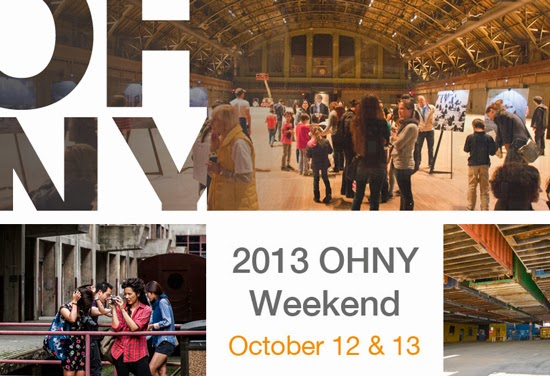
In any case, however, shutdown isn't possible just yet, as it's necessary to report tonight that tomorrow -- that's right, Tuesday, October 2 -- at long last it will be possible to see the complete listings for Open House New York Weekend, October 12-13. Tomorrow is also the start of registration, so people with advance information will already be clogging the Intertubes to grab their places in the "hot" events.

In case you're not familiar with OHNY, here's what I wrote last year. Earlier today I described it to an out-of-town friend as probably NYC's most important touring weekend of the year.


To celebrate the city's architecture and design, the 11th Annual openhousenewyork Weekend will once again unlock the city, allowing New Yorkers and tourists alike free access hundreds of sites talks, tours, performances and family activities in neighborhoods throughout the five boroughs. From private residences and historic landmarks, to hard hat tours and sustainable skyscrapers, OHNY gives you rare access into the extraordinary architecture that defines New York City, while introducing you to the people who make the city a vibrant and sustainable place to live, work, and play.
If you're not familiar with OHNY, the first thing you need to know is that the events are free. It's really impossible to give a fair idea of either the range or quantity of the offerings, which span all five boroughs and include scads of sites that aren't accessible to the public at any other time of the year, or at least are rarely accessible. The events are so numerous that the guide really deseves several weeks of close study.

Only we don't have several weeks, people! Registration starts tomorrow morning!

I assume that at some point in the morning the online version of the OHNY schedule will be reachable via the OHNY "overview" page.

The print version is once again available bound into the current issue of Time Out New York, and can also be picked up at various locations around the city, which are listed here.

Many events require preregistration, if only to control
the number of participants, but lots of others don't


It's true that a cluster of the offerings will attract high-level interest, and theyre usually not hard to recognize. If, for example, you see that Mayor Bloomberg is hosting a session on "Achievements of the Bloomberg Administration" in his living room, with coffee cake and tea served, assume that it will fill up in seconds of the start of registration (if not sooner). Remember too that these are some pretty sophisticated folks scouring the listings, and the ones that represent truly unusual access to a distinctive site are also going to be heavily subscribed.

At the same time, many events will be offered at multiple times, and in addition there are going to be lots of events that will attract much more limited response. I'm going to go out on a limb and venture that this will include many of the most interesting ones. They just don't have the raw pizzazz of the "hot ticket" events, but they may go a lot farther toward filling in your picture of how the city functions.

There's also OHNY Kids -- "tours and workshops for the whole family." Plus there's bike tours, and "opendialogue" events ("on-site talks and tours led by architects, designers, planners and scholars and a photo competition"). and who knows what all else. Usually I find there are so many offerings I'd love to do that it serves as fodder for my own explorations for the year leading up to the next OHNY.

OHNY has a blog that has been featuring previews
of events planned for this year's OHNY Weekend:


@rtifacts illuminated, General Grant National Memorial, Newtown Creek Wastewater Treatment Plant, Urban Stargazing at Woodlawn Cemetery (how cool is that?), Little Red Lighthouse, Trinity Church Bell Tower, Jefferson Market Library Tower, Cathedral Church of St. John the Divine, TroutHouse, Bronx Library Center, Citi Bike Warehouse (that's in Sunset Park, Brooklyn), Urban Post-Disaster Housing Prototype, PS 41 -- The Greenwich Village School Greenhouse Roof, Kathryn Scott Design Studio Brownstone, Suchi Reddy Apartment, Gwathmey Siegel Architects Apartment, Desai Chia Architecture Loft, Brad Zizmor Residence.


The Citi-Bike Warehouse in Sunset Park
#

Sunday, September 15, 2013

Urban Gadabout: Catching up with Justin Ferate's New York

The previously scheduled visit to Staten Island's in-development Freshkills Park had to be postponed because of Superstorm Sandy damage. The tour has been rescheduled for November 9.

by Ken

A couple of days ago I promised an update on the fall tour schedule of the Wolfe Walkers, now programmed by the peerless tour guide Justin Ferate. The brochure is available online now, with this introduction:

FALL PROGRAM: 2013

Dear Friends,

This Fall, we have an exciting selection of touring options. Our first tour of the season will view and explore a diversity of important and well-loved 57th Street landmark buildings and will also include brief tours of several art galleries. Our Autumn bus trip will take us up to Hartford, Connecticut. Here, we’ll take a private boat tour along the Connecticut River on the romantic old- time excursion boat, the Hartford Belle. (Reserved just for the Wolfe Walkers!) We’ll lunch at the highly acclaimed Italian restaurant Salute and end our visit to Hartford with a guided tour of the beloved Harriet Beecher Stowe House. To celebrate the Fall season, our intrepid bicyclist Jacqueline Goossens will be leading a special bicycle trip to Upper Manhattan and then will travel along the Hudson River toward Columbus Circle. We are also offering an often-requested walking tour of the “Mile Square City” of Hoboken, New Jersey. An unusual and special new tour will discover the multi-layered histories of Nutley, New Jersey – strolling the treasured waterfront greenbelt of Memorial Parkway (including a number of 18th and 19th century historic structures) with the Nutley Museum Director, John Simko. Speaking of greenbelts, we’ve also rescheduled the bus trip to Freshkills Park in Staten Island. Spaces are limited, so be certain to register right away! Finally, at our annual Holiday Brunch, Justin will present a lecture celebrating The Centennial of Grand Central Terminal. There are lots of options. We look forward to seeing you all!
The Wolfe Walker Committee

Here are abbreviated descriptions of the tours.

57th Street: Art! Music! Culture!
Walking Tour with Justin Ferate
Saturday, September 28, 2013, 1pm to approx. 4pm
57th Street has long been a treasure trove of artistic, musical, and cultural delights. Join noted Tour Leader Justin Ferate as we discover the history, legends, and lore of this fascinating thoroughfare. Among the various sites will be Trump Tower, Tiffany’s, the Fuller Building, the Solow Building, Carnegie Hall, Steinway Hall, the Art Students’ League, and a selection of art galleries. Rediscover old friends, discover remnants of the street’s residential past, and view high-end new buildings. Tour will include several special interior visits.

$20 in advance, $23 on-site

Hartford Belle Boat Cruise & Harriet Beecher Stowe House
Bus & Walking Tour with Justin Ferate

Saturday, October 5, 2013, 7:45am to approx. 7pm
Delight in the brilliant colors of autumn as we travel by motor coach through the leafy landscapes of Connecticut en route to the capital, Hartford. We’ll begin our visit with a private guided boat cruise up the Connecticut River on the intimate riverboat Hartford Belle. beautiful intimate riverboat reminiscent of simpler times. She has a mahogany-trimmed enclosed cabin. Our ever-gregarious Captain Brad Fenn likes to keep the windows open on sunny days to capture the autumn breezes. There is ample seating or some may want to stand on the bow to get the best views along the majestic Connecticut River! After lunch at the Italian restaurant Salute, a stone’s throw from Hartford’s centrally located Bushnell Park, we will travel to the Harriet Beecher Stowe House – an historic house and National Historic Landmark in an artistic neighborhood known as Nook Farm -- which was the home of Harriet Beecher Stowe, author of Uncle Tom's Cabin, for her last 23 years. We will take a special guided tour of the home.

Limited to 40 participants. Advance reservation only, $135 (no on-site registrations)

Upper Manhattan/Hudson River Bicycle Ride
Biking Tour with Jacqueline Goossens
Saturday, October 12, 2013, 10am to about 3-3:30pm
Join the Wolfe Walkers and the enthusiastic leader Jacqueline Goossens for our free autumn bicycle tour. This tour is conceived for those who want to take a leisurely ride to experience the varied New York environments through which we’ll travel. Meeting at Columbus Circle, we will ride along Central Park West to 110th Street. Continuing north along Frederick Douglas Boulevard, we’ll travel west to the Hudson River bike path. We’ll stop at Fairway Market to purchase lunch, which we can eat in Riverside Park. After lunch, we’ll ride south along the Hudson River, Riverside Drive, and south toward the Hudson River Boat Basin at 79th Street. The tour will end at 57th Street – near Columbus Circle.

Limited to 8 people, free

Hoboken -- "Mile Square City" or "Heaven, Hell, or Hoboken!"
Walking Tour with Justin Ferate

Sunday, October 27, 2013, 9:30am to about 1pm
Just a short trip across the Hudson River is the very vibrant and desirable suburb of Hoboken, New Jersey. New waterfront developments and immense loft conversions add a new vitality to this former working class Victorian community. Join our popular Tour Leader Justin Ferate as we rediscover the “Mile Square City.”

Take PATH to the restored Hoboken train station originally designed by architect Kenneth Murchison. Examine the new riverside housing and stroll the streetscapes of gracious 19th Century architecture. Learn of Hoboken’s history: from baseball to Stephen Foster; from steam railways to the first American brewery; from Maxwell House Coffee and Lipton Tea to “ol’ blue eyes,” Frank Sinatra.

$20 in advance, $23 on-site (plus PATH fare)

A Walk in the Park: Nutley, New Jersey
Walking Tour with John Simko (and Justin Ferate)

Saturday, November 2, 2013, 10am to about 12:30pm
A century ago a magazine editor living in what is now known as Nutley, New Jersey urged his friend Samuel L. Clemens (Mark Twain) to pay him a visit. ''There isn't much that is prettier than this end of New Jersey,'' he wrote. ''It is all upland, tumbling into shallow valleys and bright sunny reaches along the Passaic River, and hillsides white as snow with daisies, and everywhere trees.''
Today, the Empire State Building is clearly visible from some of Nutley's highest points, but the pastoral serenity is preserved in the township's 100-acre park system that is sprinkled throughout this suburban community – a park system that is considered to be the “crown jewel” of all Essex County. We’ll walk about a mile, with many stops along the way. A list of possible luncheon destinations will be distributed on the tour. Celebrate Nutley history with a walking tour led by John Simko, the Nutley Museum Director.

$20 in advance, $23 on-site (plus bus fare)

Discover the Creation of Freshkills Park
Ferry & Bus Tour with Justin Ferate

Saturday, November 9, 2013, 9:15am to about 12:30pm (Manhattan to Manhattan)
Join Justin at Manhattan’s Staten Island Ferry Terminal to begin this discovery tour of the new Freshkills Park! In Staten Island, we’ll meet a special bus and a member of the New York City Parks Department who will take us on this very unusual adventure. At 2,200 acres, Freshkills Park will be almost three times the size of Central Park and the largest park developed in New York City in over 100 years. James Corner of Field Operations, the same firm that created the stunning landscape designs for the High Line, produced the master plan to guide the long-term development of Freshkills Park.

All tour participants will be required to sign a Department of Sanitation liability waiver. $20 in advance (no on-site registrations)

Holiday Brunch & Slide Lecture by Justin Ferate
Brunch at Pete's Tavern, E. 18th St. at Irving Pl.
Slide Lecture: Groundbreaking for a New New York City!
The Centennial of Grand Central Terminal

Sunday, December 15, 2013, 12n to 3pm
Share an end-of-the-year meal with other Wolfe Walkers at our long-time holiday venue, Pete’s Tavern. See the table where O. Henry wrote his beloved Christmas classic, “The Gift of the Magi.”

In 1903 – a little over 100 years ago – the New York Central Railroad was legally obliged to either “Electrify or Leave Town!” In response, the train company made an impressive and nearly inconceivable decision. Blasting an immense trench down the center of stony island of Manhattan -- from 42nd Street to 97th Street -- the railroad placed their newly electrified trains underground. Above the railroad tracks, the railroad then created an elegant, luxurious new thoroughfare named PARK AVENUE -- transforming one of the ugliest places on the planet Earth into one of the most world’s desirable residential addresses, which still remains exceptionally chic 100 years later. The centerpiece of this great “makeover” was Grand Central Terminal, which celebrates its 100th anniversary this year! Justin Ferate shares a photographic history of the creation of Grand Central Terminal, Park Avenue, and the invention of Midtown Manhattan!

Brunch features an array of selections from which to choose, and includes one drink. Limited to 38 people. $25 in advance, $30 on-site if space permits

Registration is by mail only, and since it's handled entirely by volunteer labor, you don't get an acknowledgment. If you're unsure about whether you're registered, you can always call Mickie Watterson to check. Warning: The big events like the bus trip and boat ride to Hartford always book up, and usually pretty quickly, so if I were you, I wouldn't delay. Also, I did the Holiday Brunch at Pete's Tavern for the first time last year and had a swell time; people tend to remember about it as the day approaches, so again, it's wise to book ahead. -- Ken
#

Friday, September 13, 2013

Urban Gadabout: Catching up with Jack Eichenbaum


One of NYC's great buildings: the New York Public Library building on Fifth Avenue at 42nd Street

by Ken

It was a big commitment last weekend, especially for someone still recovering/rehabbing from knee-replacement surgery, but I couldn't resist signing up for Municipal Art Society walking tours with four of my favorite tour leaders -- on Saturday, Matt Postal ("Upstairs Downstairs" in Manhattan's East 60s) and Jack Eichenbaum ("From Forest Hills to Corona" in Queens); on Sunday, Joe Svehlak (the half-mile expanse of Nassau Street in downtown Manhattan) and Francis Morrone (three very different urban landscapes in Brooklyn -- the Robert Moses-era Metro-Tech, the c1990 Metro-Tech campus, and still-in-progress Brooklyn Bridge Park).

It was especially good to see Jack back in action, since he'd had to cancel a couple of tours this summer after banging up his knee. And the Forest Hills-to-Corona walk amply demonstrated his emphases as an "urban geographer" -- the way contrasting geography influences development. As I've mentioned a number of times, when Jack asks you on a tour which direction we're walking in, he usually doesn't want to know from north or south, east or west; he wants us to be aware of up and down. ("Up" tends to be the good dry land where rich people gravitate; "down" tends to be marshy or mucky land that floods easily and is much tougher to develop.)

Tomorrow I'm doing another tour with Jack, for the Municipal Art Society, which is really a two-in-one, focusing on the Midtown Manhattan corridor of East 42nd Street. The year 2013 has been a blockbuster year for Grand Central Terminal, because February marked the centenary of its opening, and that opening gave a huge impetus to the development of the neighborhood. But already in the neighborhood, a couple of blocks to the west, was one of New York's greatest building, the New York Public LIbrary, begun in 1902 and finally opened in 1911. Here's how Jack describes the tour:
Maps, Realities and the People’s Palace
Saturday, September 14, 11am-1pm

Marking the centennial of Grand Central Terminal, we’ll tour the (external) GCT and Bryant Park vicinities, planned areas greatly altered since before the Civil War. Then we will see how historical cartography captures the changing urban landscape in the splendidly restored Lionel Pincus and Princess Firyal Map Division of the New York Public Library.
Jack does tours under various auspices, including his own, which is why it's important to sign up for his e-mail list, which you can do on the "Public Tour Page" of his website, "The Geograhy of New York City with Jack Eichenbaum," for advance notification of what he has in the works. Coming up is one of his Queens specialties. (Remember, Jack is Queens' official borough historian.)
What’s New in Long Island City?
Sunday, October 6, 4-6:30pm

We’ll walk from Queens Plaza to the East River waterfront. Rezoning and demographic change stemming from Manhattan spillover spark revitalization in this once stagnant industrial neighborhood. A lively arts community and restaurant scene has developed. The Plaza, where transit lines intersect, has been rezoned for hotels, condos and offices. Gantry Park, on the East River, is the perfect place to view the midtown Manhattan skyline at sunset. After the tour, enjoy restaurants and LICAO events which abound in the nearby Vernon/Jackson area. >This tour is self-sponsored with the support of Community Board 2 and the Long Island City Partnership. Meet at the fare booth on the lowest level of the Queensboro Plaza station (N,Q,7) Fee $15
For MAS Jack has two more of his Queens specialties coming up:
Flushing’s Koreatown

Saturday, October 19 11am-1pm

Koreans are the premiere small businessmen and church builders of contemporary immigration. Their center of gravity has migrated away from Central Flushing and is now sprawling east along Northern Blvd and to “Korean Villages” at LIRR stations. See surprising shops, supermarkets and unusual houses of worship. Eats include “BBQ“ and “KFC ” (Korean versions!) Be prepared to walk briskly.

Astoria
Saturday
November 23 11am-1pm

This demographically changing neighborhood is opposite Manhattan‘s Upper East Side. Italians and Greeks are being replaced by Arabs, Bosnians, Brazilians, Mexicans, and yuppies. We’ll explore Astoria from its important transportation arteries: Steinway St (a former trolley route), 31 St (under the elevated train), the Grand Central Parkway which bisected the neighborhood 70 years ago, and 30th Avenue, its café-lined promenade. Be prepared to walk briskly.
BUT THE PIÈCE DE RÉSISTANCE IS . . .

One of the things Jack is best known for is his daylong series of mini-walking tours organized around a single subway line -- most frequently "The World of the No. 7," the Flushing line, but more recently "A Day on the J," which runs from the Lower East Side through Brooklyn's Williamsburg and Bushwick and on into Queens. This summer Jack announced a tour built around my (and Howie's) old Brooklyn subway line, the Brighton line, now designated the Q train. (The line's original destination as a regular railroad was Brighton Beach, but it was eventually extended on to Coney Island.)

The tour was originally scheduled for July, but Jack banged up his knee and had to postpone it. Now it's scheduled for September 29, when it should be cooler, and also more people will have an opportunity to sign up.
Brighton Line Memoirs meandering off the Q train

Saturday, September 28, 10am-5:30pm

This is a series of five walks and connecting rides along what was once the Brooklyn, Flatbush and Coney Island RR dating to 1878. Walks take place in Prospect Park, Brighton Beach, along Avenue U, in Ditmas Park and Central Flatbush. Lunch is in Brighton Beach where you can picnic on the Boardwalk. Tour fee is $39 and you need to preregister by check to Jack Eichenbaum, 36-20 Bowne St. #6C, Flushing, NY 11354 (include name, phone and email address) Get the full day’s program and other info by email jaconet@aol.com. The tour is limited to 25 people. Don’t get left out!
The last I heard from Jack, on the "Forest Hills to Corona" walk, there was still a fair amount of space in the Q train tour, but the way it often works is that there's a flurry of registrations as the date closes in, and people wind up getting closed out. You don't want that to happen to you, do you?


COMING UP: JUSTIN FERATE'S FALL SCHEDULE

Justin, who for some time now has programmed and led most of the Wolfe Walkers tours (originated by Gerard Wolfe way back when), hasn't mentioned it as far as I've noticed among the vast quantity of tour news items he passes along to his mailing list, "Tours of the City with Justin Ferate," but the fall Wolfe Walkers schedule is in fact up. I've gotten my registrations in the mail. We should talk about them soon.
#

Saturday, September 7, 2013

Return to the Museum of the Moving Image: From "The Sopranos" to "Breaking Bad" (by way of "Rear Window")

TO MY OTHER FAVORITE
W.W.

IT'S AN HONOUR
WORKING WITH YOU.

              FONDLY

                              G. B.

by Ken

Maybe if I'd had any idea it was there, I wouldn't have been so taken aback. But suddenly there I was, standing in front of the glass case, with a pair of headphones on listening to the audio of one of the exhibit video displays, and it slowly dawned on me that I was looking at The Book!

Tell me these things don't all fit together! It was just last week in TV Watch that I wrote about the book -- the fateful copy of Walt Whitman's Leaves of Grass inscribed so affectionately to Walter White by the late Gale Boetticher! For a while I thought it was just some sort of mockup or something. But I kept looking and gradually grasped that no, this was the actual book. Okay, it's possible that the Breaking Bad props department cooked up more than one copy to cover themselves when the book was shot in Walt's bathroom, where it produced one of the series' more dramatic moments. So maybe there was another copy, and perhaps even another, on display in other museums. But there was no doubt that this was the real thing.

And then the museum guard was tapping on the glass, signaling that there was only five minutes to closing. I hadn't really left myself much time for browsing. Mostly on Thursday I had just wanted to actually get out to Astoria (Queens), taking advantage of my Rosh Hashanah PTO day (God will just have to understand) to present my about-to-expire Groupon voucher for membership in the Museum of the Moving Image, comfortably situated in part of the old Kaufman-Astoria Studios complex (part of which has for some years once again been a working studio, probably New York City's premier TV and film production studio, where shows like Cosby and Seinfeld have been filmed).

The young woman at the desk cheerfully attended to the paperwork, and when I asked if I could make a reservation for Friday evening's screening of Alfred Hitchcock's Rear Window, which I don't think I'd ever seen on a big screen, she did me one better: She produced an actual ticket, so when I made the return trip to Astoria from work last night, I could head straight to the theater.

I had meant to make the first trip on Saturday of Labor Day Weekend, when I could also have availed myself of the opportunity to see two of the last films in the summer series Fun City: New York in the Movies 1967-75,: Milos Forman's first American film, Taking Off (1971), and from the same year his countryman Ivan Passer's Born to Win. I don't think I'd ever seen Born to Win, but I sure had seen Taking Off, when it first came out, and as best I recall hated it. The museum description calls it "the sweetest of generation gap movies," but I remembered it as the hamfistedest of pseudo-parodies of '60s-'70s counterculture. But I didn't remember it as an especially New York movie, but the blurb recalled that it "was shot in and around New York during the summer of 1970," and that "the director discovered his 16-year-old star in Central Park hanging with the hippies around Bethesda Fountain." For all that New York-itude alone it might be worth another look.

Well, I didn't make it. And Sunday, when the series concluded with the classic Panic in Needle Park (also 1971) and Sidney Lumet's Dog Day Afternoon (1975, which I remembered more fondly, I wasn't available. I had a walking tour in Brooklyn's Bay Ridge scheduled, which I wound up missing. The trip from Washington Heights took me an hour and three-quarters (complicated by weekend transit changes, which I thought I'd worked around cleverly, but turned out to be not so clever), and while I'd planned to allow a full two hours, I wound up compressing that to an hour and 35-40 minutes -- close but no cigar. My time management lately has sucked. Add the hour-and-three-quarters return trip, and it was one of my longer trips to nowhere.

So my Rosh Hashanah trek to Astoria represented a comeback of sorts. I hadn't left myself a lot of time to wander around the museum, though, which is how I wound up being caught short when I stumbled across the exhibit "From Mr. Chips to Scarface: Walter White's Transformation in Breaking Bad." That "startling transformation," the museum description says, "with costumes, props, selected scenes from the series, and behind-the-scenes footage." The costumes and props were on loan from Sony Pictures Television -- including, of course, The Book. The exhibit runs through October 27, so I will definitely have to get back. I see that I missed an evening with series creator and mastermind Vince Gilligan when the exhibit opened in late July. I would gladly have forked over the $12 member price.

Then again, the interviewing was done by Charlie Rose, and that I could live without. By coincidence, in my quick wandering through the museum, the first thing I encountered, which I watched for a while before finding out what the heck it was, was an exhibition called "Cut Up" (running through October 14): "From supercuts to mashups to remixes, Cut Up celebrates the practice of re-editing popular media to create new work, presenting contemporary videos by self-taught editors and emerging artists alongside landmarks of historic and genre-defining reappropriation." I had just sat down and watched for a while, and while most of the "cut-ups" I saw seemed to me more facile than clever, there was a hilariously surreal several minutes, called either "Charlie Rose, by Samuel Beckett" or vice versa and featuring Charlie Rose interviewing Charlie Rose, with interviewer Charlie asking pompously incoherent questions and interviewee Charlie providing mostly mute but even more incoherent replies. The short was credited to Charlie Rose as executive producer, but I had a feeling that was part of the cut-up piece.

Although nothing about the joint looked even vaguely familiar, this wasn't my first membership stint at the Museum of the Moving Image. I had joined way back when, when the museum screened the first two seasons of The Sopranos, which at the time was all there was, with Season 3 still in the works -- I'm guessing it was the summer of 2000. The schedule was intense: eight episodes a weekend, two in the morning and two in the afternoon both days. And since at the time I didn't have cable, let alone HBO, this was my first direct exposure to the series, which of course I'd been hearing about endlessly. And it played simply incredibly on the big screen. Since Seasons 1 and 2 of The Sopranos comprised 13 episodes each, the series must have filled three eight-episode weekends and overlapped into a fourth. It was one of my all-time great viewing experiences, and it was a great relief to me that I was able to rearrange my life circumstances so that I was able to watch Season 3 (and subsequent seasons), albeit on a mere 31-inch conventional CRT TV.

But again, these things come around. As I believe I also mentioned last week, I just replaced my Sopranos Season 1-3 VHS tapes and Season 4 DVDs with the complete-series DVDs, which I've just begin watching on my first-ever HDTV, bought shortly after my knee-replacement surgery in April -- as a reward of sorts for my old bedroom TV having conked out just a week or two before the surgery, so that I had no TV in the bedroom in the early weeks of convalescence. (Well, it sure got me out of bed! Like I can live without a TV.) It's not quite re-creating the experience of those first two seasons, but as I've written here frequently, every time I dip into The Sopranos, whether for a bloc of episodes or an isolated one or two, the show just keeps playing better. And on DVD on the 42-inch HDTV, it looks pretty darned fine too.

Oh yes, I had a swell time at Rear Window last night. The 35mm print looked kind of grainy to me, but it was a pleasure to be able to watch the unfolding of the ongoing minidramas staged in all the "rear windows" the Jimmy Stewart character is reduced to watching all day and most of the night during his confinement to a wheelchair with a broken leg. And memory impairment can be a blessing. It can't be that long since I watched the picture on DVD, but I mercifully remembered the later plot unfoldings sketchily enough that I was able to be caught up deliciously in the final build-up.


Ah yes, Miss Torso -- the most scenic of the "rear window" vistas viewed compulsively by shut-in photographer "Jeff" Jefferies (Jimmy Stewart) in Alfred Hitchcock's Rear Window
#

Urban Gadabout: New palm trees for the World Financial Center's breathtaking Winter Garden


The Winter Garden, the breathtaking public atrium in the World Financial Center, is one of New York City's most beautiful interior spaces.

by Ken

[NOTE: This post was written to be posted on August 21, but I don't seem to have actually posted it. The time frame has changed a bit, but otherwise it seems to me still worth looking at -- especially the pictures.]

Amid the devastation of 9/11, the fate of the Winter Garden, the majestic and much-loved 10-story atrium of the Cesar Pelli-designed World Financial Center, adjacent to the World Trade Center, may not have been uppermost in many people's minds, but in fact it was pretty much totaled.


The relatively quick and genuinely masterful rebuilding of the Winter Garden correspondingly became one of the city's most heartening symbols of revival. And the center's proprietors have continued to maintain the space rigorously and lovingly -- right up to Superstorm Sandy, when the space took another hit. By then, though, the complex's owners, Brookfield Properties, were preparing to announce a substantial renovation that would mark the WFC's conversion into "Brookfield Place" (not exactly a "Eureka"-style naming inspiration; Brookfield already had Brookfield Places in its home city of Toronto and in Perth, Australia), in hopes of drawing non-financial tenants to the considerable space the company has to market.

Meanwhile, the Winter Garden is for once undergoing some transformation that is both (a) planned and (b) owing to natural causes. The grid of 16 palm trees which has been probably the atrium's most conspicuous feature is in the process of being replaced. It seems that the old trees, which in fact were new trees when they were planted in the 2002 rebuilding of the Winter Garden, had grown to 60 feet, too large to allow for further growth in the space.

So last week the old trees were chopped down, to be converted to mulch for use in gardens at local hospitals "to honor their role in the Winter Garden that made it both a place to meet and a place to rest," according to a Brookfield statement, and this week 16 new trees, about 35 feet tall, have been planted to take their place. DNAinfo.com's Julie Shapiro reports that the new occupants "will all be Washingtonia robusta trees, the same type as the previous trees," according to Brookfield.


Long life to the young(er) trees -- or at least as long as their new habitat allows.
#

Friday, March 1, 2013

Urban Gadabout: Say, NYC-area dumpling lovers, are you up for a Dumpling Crawl tomorrow (Saturday)?

There's a serious goal: to bring customers
back to NYC's Sandy-whacked Chinatown


It's dumplings, dumplings, dumplings tomorrow (March 2) in New York's Chinatown, thanks to Rally Downtown's four scheduled "Dumpling Crawls" -- at 12n, 2pm (two crawls), and 4pm. Of the two crawls at 2pm, one will be led by NYS Sen. Daniel Squadron, who hatched the idea for the "Dumpling Rally."

"[NYS Sen. Daniel] Squadron, who held his wedding's rehearsal dinner as well as his first-ever political meeting in Chinatown, passionately described the ideal dumpling as 'a rich and satisfying filling' that 'unleashes the full power' of its flavor from its dough wrapping at exactly the right moment.

"'Chinatown is full of small businesses run by independent entrepreneurs -- many of them immigrants -- who, despite all the challenges of succeeding in the city, work hard, stick with it and provide extraordinary food,' he wrote in an email to DNAinfo.com New York."


by Ken

Talk about an obvious mark! I only had to learn that a new conglomeration of downtown Manhattan businesspersons called Downtown Rally has scheduled four "Dumpling Crawls" for tomorrow (Saturday, March 2) than I was searching frantically for the "more info" and "buy tickets" buttons. I love dumplings more than just about anything on the planet.

As the invaluable NYC news source DNAinfo.com New York's Serena Solomon explains below, "Rally Downtown is a project to help businesses get back on their feet post-Sandy with events that bring shoppers through their doors once again." As I noted in the caption, the Dumpling Rally was conceived by State Sen. Daniel Squadron, as one way of bringing cash-carrying patrons back into this portion of his district which was devastated by Superstorm Sandy.

In case you can't bear to read through Serena's piece to get to it, here's the link for the page on the Rally Downtown website devoted to the Dumpling Crawls.

Dumpling Rally Looks to Bring Business Back to Sandy-Damaged Chinatown

March 1, 2013 7:14am | By Serena Solomon, DNAinfo Reporter/Producer

CHINATOWN -- To successfully eat a soup dumpling don't bother with chopsticks, according to Christine Seid, the second-generation owner of the Chinatown Ice Cream Factory.

"You have to really carefully put it onto a soup spoon and eat it in one bite so you don't break it and the soup comes out," she said, adding that waiting a few minutes for the broth to cool down is ideal to avoid burning your mouth.

This is the type of knowledge Seid and others will be passing on to amateur dumpling eaters during this Saturday's Dumpling Rally that is providing tours to some of Chinatown's best dumpling houses.

The rally, an idea from State Sen. Daniel Squadron who is a self-professed authority on Chinatown food, is aiming to bring business back to Chinatown as stores still fight to recover from Hurricane Sandy.

"That is one of our goals, to showcase the gems of New York," said event organizer Tom Gray, executive director of the Greenwich Village Chelsea Chamber of Commerce and co-founder of Rally Downtown that is organizing the tours. "People will go to places they have never been before. The event will drive traffic, raise awareness and get people to come back to these dumplings houses."

Rally Downtown is a project to help businesses get back on their feet post-Sandy with events that bring shoppers through their doors once again.

The Dumpling Rally is offering four tours this Saturday -- one at noon and 4 p.m. and two at 2 p.m. Squadron will host one of the 2 p.m. crawls.

Squadron, who held his wedding's rehearsal dinner as well as his first-ever political meeting in Chinatown, passionately described the ideal dumpling as "a rich and satisfying filling" that "unleashes the full power" of its flavor from its dough wrapping at exactly the right moment.

"Chinatown is full of small businesses run by independent entrepreneurs -- many of them immigrants -- who, despite all the challenges of succeeding in the city, work hard, stick with it and provide extraordinary food," he wrote in an email to DNAinfo.com New York.

Tickets for the dumpling crawl are $25 and include dumplings at houses such as Prosperity on Eldridge Street and Lam Zhou on East Broadway. The tour ends at the Chinatown Ice Cream factory for dessert.

"It will be a little bit cheaper, you get the social aspect, a set of chopsticks. The dumplings are included and you get ice cream at the end," said Gray. The tour also gives out a map so those who attend can return to the dumpling houses.

While the organization is yet to apply for nonprofit status, Gray said any funds left over will go to planning more business-generating events for Sandy affected areas.

Ten percent of the ticket price will also go to the Chinese American Planning Council, a local nonprofit.

"It took a lot longer for business to pick up for a long time after Sandy," said Gray. "At the very least everyone went without power."

To purchase tickets for the Dumpling Rally go to the event's website.

My first temptation was to try to sign up for one of the 2pm crawls led by Senator Squadron, who has been impressing me as one of the more watch-worthy of the city's rising pols. And I could probably get to one of the 2pm crawls from my 11am Municipal Art Society walking tour with Matt Postal, revisiting one of the Midtown Manhattan walking tours originally proposed by longtime New York Times architecture critic Ada Louise Huxtable's ground-breaking 1961 book Four Walking Tours of Modern Architecture in New York City. (Tomorrow's walk is sold out, but there may still be space in the second walk from the book which Matt is re-creating, on March 16.) But I'm thinking the senator will be wanting to talk dumplings, or maybe economic development, rather than politics, and am I really that confident of his self-proclaimed dumpling expertise? In the end I decided to play it safe and sign up for the 4pm crawl, with Julie Menin.

As it happens, I'm familiar with two of the stops, Excellent Dumpling House on Lafayette Street, just below Canal (where in fact I came very close to popping in this afternoon after a physical-therapy session, but it was just too crowded), and Prosperity Dumpling on Eldridge Street (which I first visited on a NY Transit Museum eating tour led by Saveur magazine's Todd Coleman). But I'm only too happy to go back to both! Maybe I'll even get some tips about ordering at Excellent Dumpling House. I have eaten there while on jury duty, but the menu doesn't seem terribly dumpling-oriented, merely listing a few varieties as appetizers.
#

Saturday, December 8, 2012

Urban Gadabout: Stalking owls in Inwood Hill Park

No, as far as I know this isn't the great horned owl we (supposedly) made voice contact with this evening in way-Northern Manhattan's Inwood Hill Park. But I can't say for sure it isn't. Or it could be a relative.
FINAL TALLY FOR "OWL PROWL"

Total number of owls made visual contact with: 0
Total number of owls made voice contact with: 1 (alleged)
Total amount of fun had during Owl Prowl: tons

by Ken

Now you're going to tell me you could resist an offer like this?

Owl Prowl with Mike Feller

Saturday, December 8, 2012
4:00 p.m.–6:00 p.m.

Whoooo goes there?

Bring the whole family and find out as you roam the winter woods in search of owls with Mike Feller, Chief Naturalist for Parks's Natural Resources Group. It's the beginning of their mating season so you may observe some interesting behaviors. Mike will demonstrate how to attract owls using calls.
From time to time I've noted announcements from the NYC Parks Dept. about nature-themed walks in Northern Manhattan parks featuring naturalist Mike Feller. I've done a bunch of the (similarly sponsored) walks in Northern Manhattan with the staggeringly erudite Sid Horenstein, educator emeritus at the American Museum of Natural History (and I wrote about my adventure with him in Highbridge Park), but I'd never done one of Mike's walks.

Today, finally, I got myself there for the promised Owl Prowl. It surprised me all the more because I'd already done a Municipal Art Society walking tour with Matt Postal -- the first of two walks devoted to "Millionaires' Mile" (which Matt allowed at the outset should probably be renamed "Billionaires' Mile"), this one on but mostly off Fifth Avenue from 60th Street (starting directly opposite the still-imposing McKim Mead & White Metropolitan Club) up to the Frick Collection at 70th Street.

Asked at the outset about our odds for spotting owls, Mike thought a bit before telling us that his record so far on these walks was six for six. Well, now it's six for seven. But along the way we learned plenty about owls, and in particular the great horned owls who have taken over the owl franchise in Inwood Hill Park (at the northern edge of Manhattan, one of our few parks that includes a fair amount of natural rather than manufactured terrain.) Great horned owls, Mike explained, don't like sharing habitat with other species of owls, and tend to terminate them with extreme prejudice.

I learned a great deal about what great horned owls eat, which is mostly live animals -- mice and rats definitely, but on up to skunks and squirrels and rabbits. The smaller animals are swallowed whole, and eventually the indigestible parts are ejected orally in the form of a pellet. Larger animals are torn up for swallowing, perhaps in quarters for, say, skunks. (A tour participant who lives in the area volunteers that in the years before the arrival of the great horned owls in Inwood Hill Park, the park was overrun with skunks, and then the skunks more or less vanished. The connection was "purely anecdotal," she acknowledged, adding that she sure didn't miss the skunks -- the smell was pretty bad.)

It may have been too warm still for owl spotting -- Mike registered surprise at the amount of insect activity still observable in the park at this late date. When he applied his imitation owl-hooting technique, he seemed to get a response from afar, but nothing he could do would persuade the respondent to move from his spot -- a "mellow male owl," he guessed. He ventured that we were having roughly the same effect on him that telemarketers have on us when they call during dinner.

Actually, I wasn't entirely grieving that our mellow male chose to stand, or sit, his ground. (My personal theory is that when Mike started doing his owl calls, the great horneds in the park were texting one another noting that it's probably just that crazy Mike making like an owl. And our mellow male just went back to the book he was reading.)

Whatever. It was a great walk in the park, with all manner of fascinating lore coming from Mike. There was a great turnout for the walk, including half a dozen kids of various ages -- a huge asset to the walk, with their delicious curiosity and enthusiasm. And the nice thing about our having hiked all the way up into the high sierra of Inwood Hill Park on the heading-toward-owl-country leg of the walk was that the return was almost entirely downhill.


LOOKING AHEAD

Part 2 of Matt Postal's MAS "Millionaires' Mile" series, ranging from 70th Street up to about 78th, is scheduled for Sunday, December 23, 11am-1pm. This is a problem for me, because at 1pm that day Eric K. Washington is starting an "Uptown Trinity Church Cemetery at Christmas" walk, which "precedes the city’s oldest ongoing holiday tradition, the annual recitation at the Church of the Intercession of “A Visit from St. Nicholas” (by Clement Clarke Moore, who is buried here)."

I just did a quick search, and the next walk the Parks Dept. has listed for Mike is a "Dusk Walk with Mike Feller" in Fort Tryon Park on Sunday, January 12, 4pm-6pm.
#

Sunday, May 20, 2012

NYC-- A Meal In The East Village


I didn't set out to relive my childhood. I was just going to meet Ken, a childhood friend (the guy who writes about the Gadabouts), for dinner. I had arrived the night before-- just in time for dinner at my favorite New York restaurant, Pure Food and Wine (on Irving Place in Gramercy Park). Ken isn't into vegetarian, vegan, health food or anything like that. So we met the next night and had decided to pick a restaurant from among our favorite Food Network celebrity chefs' restaurants... or his. I ate at Iron Chef Cat Cora's place in the Houston Airport on a layover coming back from the Yucatan last December and it was so abysmal that I would have been perfectly content to never eat in another Food Network star's restaurant again. But Ken gave me a choice between Geoffrey Zakarian's Lamb's Club, a Mark Murphy restaurant and Alex Guarnaschelli's Butter.

I immediately mixed Mark up with Scott Conant, who is an anti-health fanatic so I didn't even bother to look at Murphy's restaurants online. In any case, my favorite Chopped chef is Zakarian, who I think is the most interesting chef between the three. Ken suggested the Lamb's Club and I was leaning in that direction until I saw the menu online, which didn't look very vegan-friendly or health conscious at all. So, by default, it was Butter, in the midst of their 10th anniversary celebrations. Aside from seeing Ken, the best part of the experience was getting there. It's in the East Village, just off St. Mark's Place, where I spent years in the '60s working and playing. The area was like a second home to me. But, my God, it's so changed now. Not just blights like Starbuck's, there was even a Pinkberry's... right on St. Mark's itself. It's funny how wide-eyed tourists are drawn to "exotic" seedy places-- like the East Village-- and then want to make it comfortable for themselves by transforming it into places that cater to people who go for the Pinkberries. It's always that way. But this was my one and only childhood we're talking about here-- where I scored my first weed and where I saw every Velvet Underground performance at the Exploding Plastic Inevitable at the Dom.

And just down the street and around the corner down from Cooper Square on Lafayette is Butter. It's across the street and half a block up from the Astor Place Theater or Playhouse (434 Lafayette Street), another place where I spent an inordinate amount of time. It was 1965 and I was a freshman at Stony Brook, president of the freshman class and I got turned on to the subversive musical missing link between the beatniks and the hippies, The Fugs. I escaped from Suffolk County at every opportunity and hung out at Fugs shows. I hired them for the Freshman Class dance. They got the joke. The captain of the [some sport] team, Bob O'Connor, didn't and threatened to beat me up when his girlfriend was subjected to "kill For Peace" and "Boobs A Lot." That was the first time I was ever aware of having met a Republican. A year or so later I wound up in a jail cell with Tuli Kupferberg, Ed Sanders, (+ Doctor Spock and Allen Ginsberg) for protesting the War in Vietnam. But I never really looked at the plaque on the building housing the Astor Place Theater-- now the home to some Las Vegas commercial enterprise for suburbanites called the Blue Man Group-- until I was waiting for Ken to arrive for our dinner at Butter .

It's more than just a childhood memory for me. Turns out it's an historic landmark for everyone. The building, once 9 row houses on the most exclusive street in Manhattan, only has 4 attached houses remaining. It still looks awesome architecturally. It's a Greek revival building-- known both as Colonnade Row and LaGrange Terrace-- from the 1830s and built by Seth Greer in honor of the Marquis de La Fayette's estate, La Grange, in France. It-- the NYC place currently occupied by the Blue Men-- was once home to John Jacob Astor, an opium smuggler and America's first bona fide multimilionaire. Other residents of the swanky 26-room homes included Washington Irving, Cornelius Vanderbilt and President John Tyler. The street was a cul-de-sac back in the day (theirs, not mine).

Dinner was OK. Ken loved it in fact. My appetizer was among the best-prepared octopus I've ever tried, grilled with harissa, served over a orange and marcona almond allade with heirloom potatoes. Worthy of the long walk downtown. My entree, grilled salmon was far less successful, nothing to complain about but nothing remotely special either. Would I go back? Probably not. New York is filled with better places, although this, unlike Cat Cora's place in the Houston Airport, is certainly a good restaurant.

Sunday, July 3, 2011

Urban Gadabout: Inside the Revolutionary Apple with a co-author of "Inside the Apple"

James explained that the fence around Bowling Green in Lower Manhattan is not only one of the city's oldest surviving artifacts but a participant in some key historical events.

by Ken

Is there any traveler who hasn't become wholly dependent on the Internet? Whether it's for scouting destinations, gathering information, finding timetables, making reservations -- even for a humble urban gadabout, it's hard to imagine doing it these days without the staggering range of resources online.

Online is how I do essentially all of my planning with my "regular" tour providers, New York's Municipal Art Society, New York Transit Museum, and Urban Park Rangers. I'm so booked up for the summer that I have hardly a weekend "day off," and on a lot of those days I'm doubling up. Still, I'm aware that this only scratches the surface of what's available out there, so Friday, with a thinned-out schedule thinning for the 4h of July Weekend, I did some online searching, and stumbled onto, insidetheapple.net, the blog of Michelle and James Nevius, wife-and-husband authors of a combination history of New York and guidebook called Inside the Apple, and learned that on July 3rd James would be doing a "Revolutionary War Walking Tour" in Lower Manhattan, for which, as of a post from a couple of days previous, they still had places.

So I followed the instructions for e-mailing a reservation request and soon got back a confirmation, which left only the consideration of weather, which today started out dreadful, with intermittent heavy rain and overcast, and a not especially sunny forecast. Nevertheless, James sent out an e-mail to the reservation list expressing the hope that the storms would pass through by our scheduled assembly time, 4pm said, "Thus, I am going to be at the meeting place at 4PM to lead the tour and I do hope you will be too! Bring an umbrella, of course, and good humor, and I'm sure will have a great time."

So as soon as I finished puttering around with Bruno Walter and the Siegfried Idyll, I set out for Peter Minuit Plaza, in front of the Staten Island Ferry, and incredbily, just about the whole group of 25 walkers turned up. (As James pointed out, you're apt to get a bunch of no-shows even in perfect weather.)

And through intermittent, sometimes heavy rain, our hardy band trooped through a host of locales where way back in Revolutionary New York events of significance happened, though as is true of almost all of our two centuries of colonial history, first Dutch and then English, hardly anything except streets (and many street names) survives from that time. (A particular bête noire of James, we discovered, is the relative lack of attention that's been given to our four-century-old city's English century. Everybody loves the Dutch century, he points out, and of course the two centuries-plus since the Revolution are wildly popular. But the English century may be too closely connected with English rule, the city itself having been not just the site of the English military command but a center of Loyalist sympathy and activity.

James himself is wildly charming and personable, and an easygoing fount of information, so the tour was a resounding success. We wound up walking up Broad Street to the corner of Broad and Wall, and the Federal Hall that's not the Federal Hall where George Washington was inaugurated as our first president but occupies the same site (in much the way that what now passes for Fraunces Tavern, a famously favorite hangout of George Washington, is a re-creation of the building from Washington's time. Walkng up Broad Street we passed my office building, 20 Broad, and by then I had learned that there wasn't any great canal-like purpose to the canal that originally ran up the middle of Broad Street, as is described in the history of the street that's engraved in the new curbside that was created when the street was repaved with stones -- and security outposts -- from Beaver to Wall Streets a couple of years ago.

I was happy to buy a copy of Inside the Apple from James (I like the idea of a larger chunk of the purchase price going into the authors' pockets), and am just starting to get to know it. In an introductory note, Michelle and James explain:
The goal of Inside the Apple is to give you a different pathway into the city's long and rich history. While there are many books that focus on New York's notable events and famous people, ours is instead organized around the places where those events took place. By grounding the narrative in sites that you can see and visit, we provide concrete, tangible, connections between the city of today and its intriguing past.

People have long tried to answer the question: What makes New York unique? We feel the answer is deceptively simple: more than any other American city, it is primarily experienced on foot. . . .

As this suggests, the history-based narrative is grounded in places, with lots of cross-referencing to related chapters, and there are 14 full-fledged walking tours at the end. I'm looking forward to getting to know the book better.
#

Monday, May 30, 2011

Beaches (in which within some 17 hours I set foot on two NYC area beaches for the first time)

You should be able to click on this to enlarge, and if you do, I won't have to repeat what it has to say about horseshoe crabs. Oh, I may anyway.

by Ken

I didn't see the above Yahoo notice until just now, when I was scrounging online for "illustrative" material regarding Brooklyn's Plum Beach. (You'll notice here that it's sometimes spelled "Plumb Beach," but the general usage seems to be that it's Plum Beach, named for beach plum trees that are supposed to grow in this marshy area on Rockaway Inlet, east of the mouth of Sheepshead Bay (and, therefore, of the eastern extremity of Coney Island). But it gives a pretty description of the event I surprised the heck out of myself by taking such a journey from the conceptual-theoretical stage ("you know, I could actually do this, and it might be interesting") to the actual-journey stage. It was a journey that, from way-northern Manhattan, took more than the two hours I had allotted on the route I'd worked out (the no. 1 train to the no. 2 train to the B44 Limited bus to its terminus, then hoofing it) -- almost two and a half hours, in fact.

And at the several "junction" points, as it became clear that I wasn't going to come close to making it by 8pm to this place I'd never in my life heard of before let alone been to, I told myself that the sensible thing to do would be to chalk it up to a noble effort and head back home. Some other time I could complete the journey -- the beach, after all would still be there.

Yes, but would the horseshoe crabs?

But I didn't, and at nearly 8:30, when I finally saw up ahead what looked to be a bunch of people gathered in front of what I seemed quite likely to be the Plum Beach Comfort Station, the designated meeting place, I began to imagine that perhaps I hadn't entirely missed the event. And indeed I hadn't.

I missed the start of Urban Park Ranger Andrew's discussion of horseshoe crabs, explaining that their habitat extends . . . oh, I don't remember, but something like from the Gulf of Mexico all they way up the east coast of North America (there are also Pacific horseshoe crabs, we learned, on the west coast of North America and the east coast of Asia), and whatever it is, it's also a basic bird migration path, because horseshoe-crab eggs, which apparently chock full of body-building fat and protein, are super-good eats for our feathered friends. And in our area, the salt-marsh beach of Plum Beach (Andrew thinks of the whole coastal region that is now Greater New York as essentially a giant salt marsh, albeit a now-much-compromised one) is prime mating territory for the horseshoe crabs during their mating season, which locally runs about two and a half months, from April to mid-June, with moonlit nights especially favored, not for romantic reasons, of course, but for the help it provides them in finding their way to the beach and finding each other, the only reason they come onto the beach.


As the sun set, we set out in search of these ancient creatures -- who, by the way, can go a full year without eating -- and found a lonely male, but also what looked to Andrew to be a mass of horseshoe-crab eggs, which matched the description he had just given in response to a question of what the eggs look like, but surprised him because normally the female (who's way larger than the male, by the way) buries the egg clusters in the sand to provide them some protection from predators from air, sea, and land. However, someone with a smart phone was able to provide googled confirmation horseshoe-crab eggs were indeed what we were looking at.

Considering how much Andrew was able to tell us about these remarkable creatures -- and there were lots of good questions from the assembled horsehose-crab voyeurs -- it was cheering when he wasn't sure about the answer and allowed that he doesn't know everything about horseshoe crabs. As darkness set in, the crabs became bolder about venturing onto the beach, and Andrew was able to pick up mating pairs of them, who disengage with great reluctance. By the time the official presentation drew to a satisfying close, and Andrew said he was going to continue walking the beach and anyone who wanted to join him was welcome to, a shrewd hard core of us -- more, apparently, than he expected -- eagerly clustered around him, and the best part of the night, with full darkness (but a few people carrying small lights so we could see something), ensued. The horseshoe crabs were doing it all over the beach, and we were privileged to witness an important piece of the hemisphere's ecological balance taking place before our amazed eyes.

I'm embarrassed to say that I've only recently become aware of New York's Urban Park Rangers, who are a treasure. They perform all sorts of functions for the city's Parks Department, but one of them is conducting terrific tours like this throughout the city's parks. (In the only one I've taken so far, of the water course of Brooklyn's Prospect Park, on a grimly overcast Sunday afternoon, I wound up having a one-on-one tour with Ranger Vinnie, which was shortened only a bit by an ensuing downpour. The Urban Park Rangers, I had been told, come prepared to do their thing come what may.)

The return trip from Plum Beach again took nearly two and a half hours, even with a spectacular connection to the returning B44 Limited bus. I wasn't even sure I knew where the return route started, but no sooner did I think I had found the correct bus stop than the correct bus rolled in to confirm it! Fortunately, with the holiday today, I didn't much care how late I got home. And while I know I spent nearly five hours in transit, what a night!

Then I was awakened about 5am by what I realized after a moment was a torrential downpour outside, which seemed to constitute a dramatic thumbs-down on some possible activities I'd scouted for Memorial Day. I could have done one or both of a pair of Central Park tours, in areas and/or from perspectives that would be new to me. Or there was a link I'd found to a walking tour of Jones Beach, the beach that Robert Moses build on an island off the south shore of Long Island in the '30s. In nearly 50 years of living in New York, for as much as I've heard the storied name of Jones Beach, I'd never set foot there.


When I tuned in a weather forecast, it seemed pretty insistent that the rain was over, and we had a good, sunny day in store, and so I duly dragged myself to catch the 11:10 Long Island Rail Road train to Freeport, successfully met the Shorewalkers group, and was eventually able to crowd onto an N88 bus, which I was delighted to discover took my regular unlimited Metrocard, and which duly slow-mo-ed its way along the parkway (also built by Robert Moses, naturally), on what had indeed developed into a prime beach day for the first weekend of "the season," and was eventually disgorged at the western side of the Jones Beach State Park.

It's a lovely spot, though less crowded than I would have expected. Just wait till Fourth of July, I was thinking. But I won't be there. It's a lovely spot, and I'm glad I did it, in the company of people familiar with the place, and it was even worth the $16.50 round-trip train fare to do it once. It's a beach. A nice beach, but just a beach. I can cross it off my "things to do, maybe" list, though.

And tomorrow it's back to work. Sigh. Well, at least I did something this weekend. And how was your holiday weekend?
#

Monday, April 25, 2011

By itself worth the trip to Staten Island's Snug Harbor Cultural Center: The Noble Maritime Collection

The houseboat that seaman-artist John A. Noble used as a studio (mounted on a barge on the industrial Bayonne side of the Kill Van Kill, which separates New Jersey from the north shore of Staten Island) was laboriously disassembled, transported, reconstructed, and painstakingly restored in the Noble Maritime Collection, a constituent of Staten Island's Snug Harbor Cultural Center. During Noble's lifetime, the houseboat-studio was featured in a 1954 issue of National Geographic.

by Ken

As I mentioned Friday night, my principal activity yesterday was a Municipal Art Society all-day trip to and walking tour of Snug Harbor Cultural Center on the north shore of Staten Island. The weather was lousy, but held up well enough for tour leader Francis Morrone, a noted architectural historian (best known for his extensive writing on the architecture of Brooklyn, but he's quick to point out that it has been a largely accidental "specialty," and some of the best MAS tours I've taken with him, like this one, have been in other boroughs), to give us a splendid introduction to the history of the first five buildings (known, efficiently, as Buildings A to E), all in the Greek Revival style that was in vogue in the early 1930s, for the "decrepit" sailors' home, Sailors' Snug Harbor, funded by the will of Robert Richard Randall -- a fascinating story in its own right.

"Temple Row": the original five buildings, in Greek Revival style, for what was then Sailors' Snug Harbor and is now the Snug Harbor Cultural Center. The central building, "Building C" -- begun in 1931 and finished in 1933 -- was discovered as late as 1970 to have been designed by the massively influential architect Minard Lafever. (Other buildings were built, Francis explained to us, from Lafever's wildly popular published plan books.)

At its zenith, Sailors' Snug Harbor housed some 1000 retired seamen who upon being no longer fit for seagoing had no place on dry land to "retire" to. With changes in the way maritime commerce is conducted in the 20th century, not to mention social innovations like Social Security, the haven enjoyed steadily declining use, until finally the last residents were moved to a new facility in North Carolina. Over the clamoring of developers eager to get their clutches on the extraordinary site, with immense effort on the part of the rising preservation movement of the 1960s most of the site was eventually landmarked and designated for use as a new Snug Harbor Cultural Center, already home to an assortment of constituents, with the rest of the site still very much a work in progress.

We actually benefited from the lousy weather. It encouraged our leaders, Francis and the MAS's director of tours and programs, Tamara Coombs, herself a Staten Islander, to revise the original plan for the afternoon to concentrate on indoor-type activities, notably allowing us additional time in the John A. Noble Maritime Collection, which occupies Building D. We were already scheduled to eat our lunches there (we had been instructed to come sack-lunch-equipped) but wound up with an extra hour to explore a museum I'd never heard of, but which has become one of my prized spots in the city. Now that I know what and where it is (Snug Harbor, by the way, is a barely 10-minute bus ride from the St. George Staten island Ferry terminal), I definitely plan to go back. As I said to our incredibly gracious and informative host (I feel terrible for not getting his name -- the collection's assistant director, Ciro Galeno, perhaps?), the Noble Collection is a destination worth the trip by itself.

John A. Noble was a seaman-slash-artist, who developed an early fascination for the way the sea tested the men who made their living sailing it, and for a number of years made his living at it, but gradually retired from active seagoing when he discovered he could make a living as an artist of the sea. He drew and painted, but discovered he had a special affinity for lithography, which also provided him with a regular source of income. Noble's parents, both artists, split their time between France, where the younger John was born, and the U.S. The elder John Noble, a painter, somehow managed to be known in France as "Wichita Bill." One of the remarkable exhibits in the museum is a room called "The Atelier of Wichita Bill," a painstaking reconstruction, using actual family objects, of the senior John Noble's studio in France.

Noble's passion for tugboats is well documented in the Noble Maritime Collection's current exhibition on the subject. As our host pointed out to us, tugboats are still an active part of harbor life, and the exhibit has drawn a lot of visitors just for their interest in the tugboat life.

Probably the most fascinating exhibit is the transplanted and restored houseboat that Noble used as a studio, eventually mounted on a barge on the industrial Bayonne side of the Kill van Kull, which separates New Jersey from the northwestern corner of Staten Island. His bio on the Noble Maritime Collection website (noblemaritime.org) explains:
From 1928 until 1945, Noble worked as a seaman on schooners and in marine salvage. In 1928, while on a schooner that was towing out down the Kill van Kull, the waterway that separates Staten Island from New Jersey, he saw the old Port Johnston coal docks for the first time. It was a sight, he later asserted, which affected him for life. Port Johnston was "the largest graveyard of wooden sailing vessels in the world." Filled with new but obsolete ships, the great coalport had become a great boneyard. In 1941, Noble began to build his floating studio there, out of parts of vessels he salvaged. From 1946 on, he worked as a full-time artist. Often accompanied by his wife, he set off from his studio in a rowboat to explore the Harbor. These explorations resulted in a unique and exacting record of Harbor history in which its rarely documented characters, industries, and vessels are faithfully recorded.
.
Along with the restored studio houseboat itself, the exhibit includes wonderful photographs showing how the houseboat was actually moved to and then into the museum and then restored. As our host (given his tremendous hospitality and helpfulness, I feel terrible for not getting his name -- the collection's assistant director, Ciro Galeno?) pointed out, the story of how the exhibit came to be is probably at least as fascinating as the exhibit.

And throughout the museum there is a sensational attention in the presentation to context, with writings of Noble's to provide background for his artwork, and all manner of objects, from Noble and a wide range of other sources, to fit both Noble's life and work and the history and mission of Snug Harbor in context. There is, for example, a room that's been reconstructed to the state it would have been when it housed a pair of Snug Harbor residents. There's a room that has been left unaltered for a glimpse of the state the building was in when the museum was created in Building D.

The museum's executive director, Erin Urban, had met and interviewed Noble not long before his death and became fascinated by both his life and his work, and after his death determined that the latter needed to be made accessible, out of which came the idea for the Noble Maritime Collection, taking full advantage of its constituency in Snug Harbor Cultural Center. Apparently through sheer force of will Urban has made into a reality, with a staggering range of activities, and support not just from funders but from a small army of volunteers known as the Noble Crew, whose estimated $1 million worth of labor she has paraded before all manner of potential donors to raise more money.

If you're in the city and have a free day for the expedition, don't miss the Noble Maritime Collection. The gallery is open Thursday-Sunday, 1-5pm.


SPEAKING OF GREAT NYC OUTINGS, A REMINDER ABOUT "THE WORLD OF THE #7 TRAIN" THIS SATURDAY

The last I heard there were still openings for what "urban geographer" Jack Eichenbaum calls his "signature tour," coming up this Saturday, April 30 -- an all-day exploration of selected sites along the route of the no. 7 subway line to Flushing in Queens, which I mentioned recently. Jack is a terrific tour guide, and this is some of his favorite turf. Here again is his description:
THE WORLD OF THE #7 TRAIN 10am-5:30pm SATURDAY, APRIL 30, 2011
This series of six walks and connecting rides along North Queens’ transportation corridor is my signature tour. We focus on what the #7 train has done to and for surrounding neighborhoods since it began service in 1914. Walks take place in Long Island City, Sunnyside, Flushing, Corona, Woodside and Jackson Heights and lunch is in Flushing’s Asiatown. Tour fee is $39 and you need to preregister with Jack Eichenbaum. The full day’s program and other info is available by email jaconet@aol.com. Questions? 718-961-8406. The tour is limited to 25 people. Don’t get left out!

You can also get information on Jack's website. I sent my check in as soon as I heard about the tour. It sounds to me like a unique opportunity.
#

Sunday, April 3, 2011

Exploring NYC, Part II

I'll explain in a moment why I'm presenting this screen shot from Jack Eichenbaum's "Geography of New York City" website, geognyc.com, which I encourage anyone interested in getting to know NYC better to check out. (You can click on it to enlarge it for enhanced readability.)

by Ken

And when I say "a unique tour opportunity," I mean a unique tour opportunity. If you can't wait to find out about it, you can scroll down straightaway to "THE EXCITING OPPORTUNITY."

In writing sketpically last night about the "miraculous" transformation of Times Square, which NEA Chariman Rocco Landesman (who as head of the Jujamcyn Broadway theater chain played an active role in that transformation) explained in his keynote speech at the Municipal Art Society's annual meeting this week he is promoting as a model for cities all over the country seeking major new development, I mentioned that I had joined the MAS for its walking tours. Tonight I want to talk about that a little more, and in the process clue you in to this exciting upcoming opportunity, which may not be quite once-in-a-lifetime but is so exciting, at least to me, that I want to try to spread the word to people who would jump at it if only they knew about it.

(Again, if you want to skip the blather and get straight to "the exciting opportunity," feel free to scroll down to "THE EXCITING OPPORTUNITY." I won't take it personally. Well, that's not quite true. I suppose I take everything personally, but that amounts to the same thing.)

I also mentioned last night that I had two MAS tours booked for this weekend, and by coincidence, for those who believe in coincidence more than I do, today's happened to offer which are surprisingly inexpensive, especially for members (typically the two-hour tours are $10 for members, $15 for nonmembers; longer ones -- including several of the new ones I signed up for yesterday -- are naturally more expensive, but not much), and surprisingly (at least to me) helpful in enabling you to look at even parts of the city you may have thought you knew pretty well and begin to see them through the eyes of someone who has better, smarter ways of looking at them.

I suppose major cities have always had walking tours of a sort, but the kind of historical-mindedness that has made them flourish seems to me a phenomenon of recent decades. And for me the whole thing is brand-new. I don't know why I waited this long to avail myself of the opportunities; on any given weekend day there seem to be dozens of them around the five boroughs, and for that matter stretching into the whole metropolitan area. I guess I've done so much tramping around at least portions of the city over the decades I've lived here that I mistakenly imagined I didn't need that kind of "prompting." In fact, even with all that tramping, there are large swaths of the city that are pretty much terra incognata to me, and as I just said, I've learned as much touring parts of the city I thought I knew pretty well.

Times Square, to pick a random example. Last night I described the sense of aloneness feeling that I was the only one at the annual meeting of the MAS who wasn't so absolutely certain that the miraculous rebirth of Times Square over the last couple of decades is miraculous but harbored the whisper of a doubt that it's even a good thing for the vitality of the city. I'm sure I was exaggerating. It felt that way, especially when that audience member challenged the two-person panel on the Times Square rebirth for failing to give enough credit to Disney. For some of us the mind-numbing blandness and mush of Disney is an all too apt symbol for, well, the mind-numbing blanndess and mush of the "revitalized" Times Square, which seems to exist to shake fistfuls of moolah out of folks who, in fairness, seem only too eager to spend it, on crappy blockbuster musical entertainments, wildly overpriced schlock merchandise, and wildly overpriced schlock food.

It might be stressed that what Chairman Rocco, an honorable man who seems to genuinely believe in his vision of using the arts as the basis for economic redevelopment, understands by "arts" does seem to place a premium on crappy blockbuster musical entertainments. There actually are other visions of urban life, cultural life, and urban cultural life. The problem is that while there are a lot of people out there who might support their efforts, they're scattered and hard to find, whereas the audience for what Chairman Rocco understands by "arts" seems to be out there in abundance just waiting to be told what to do to be officially "entertained."

My MAS tour today put me squarely in contact with the other end of the arts spectrum. It was a "tour" of the East Village block of East Fourth Street between the Bowery and Second Avenue which has become the city's second-only designated "cultural district" (and the only one in Manhattan; the other is in Brooklyn, around the Brooklyn Academy of Music, of which our guide for this tour, Lawrence Frommer, will be leading an MAS tour on June 4), a block on which numerous shoestring arts organizations had taken root, and by coincidence (again?) the block on which one of the city's most storied theater enterprises, the late Ellen Stewart's LaMama E.T.C., found its enduring home.

It was a thrill to encounter the passion and energy of the director of FAB (Fourth Arts Block), the nonprofit organization founded in 2001 to give these for the East 4th Street Cultural District, who joined us on the tour, and also introduced us to some of the people working on that block. Tamara and her associates play all the angles, working with government and funding organizations as well as community businesses to help sustain and promote the life and activities of the district arts organizations, and indeed organizations outside the immediate district with which FAB networks. The kind of art they promote clearly isn't for the mass audience to which shows like Spider-Man: Get Off My Lawn are aimed, but they're essential to the vitality of city life, and indeed make the city a vastly more livable place.


THE EXCITING OPPORTUNITY: AN ALL-DAY PILGRIMAGE
ON THE NO. 1 TRAIN, NYC'S INTERNATIONAL LIFELINE


What got me started on this whole walking-tour thing was a bunch of the New York Transit Museum's tours, including an especially illuminating one about the engine for economic development created by transit "nodes," places where multiple subway lines intersect, starting with Times Square, which is unlike anyplace else in the city, sitting as it does atop the Sixth Avenue IND, Broadway BMT, Seventh Avenue IRT, Eighth Avenue IND, IRT Flushing, and crosstown shuttle lines. The guide for that tour, Queens's borough historian, "urban geographer" Jack Eichenbaum, had an uncanny eye for pointing out the buildings and street life of the area reflect the history of the area's transit development, and then he did the same for Queens Plaza and Jackson Heights in Queens.

The subway lines crossing those Queens nodes in both cases include the IRT Flushing line, the No. 1 train, which is one of the city's most fascinating lifelines, a veritable international lifeline. And on April 30 Jack is offering what he describes as his "signature tour."
THE WORLD OF THE #7 TRAIN
10am-5:30pm, SATURDAY, APRIL 30


This series of six walks and connecting rides along North Queens’ transportation corridor is my signature tour. We focus on what the #7 train has done to and for surrounding neighborhoods since it began service in 1914. Walks take place in Long Island City, Sunnyside, Flushing, Corona, Woodside and Jackson Heights and lunch is in Flushing’s Asiatown. Tour fee is $39 and you need to preregister by check to Jack Eichenbaum, 36-20 Bowne St. #6C, Flushing, NY 11354 (include name, phone and email address) The full day’s program and other info is available by email jaconet@aol.com The tour is limited to 25 people. Don’t get left out!

I got my check in the mail the day I saw the announcement. This promises to be a memorable occasion, and I know Jack still has openings. Frankly, I want to make sure he's got enough people registered to make it a "go." So I want to be sure all the people who would want to know about it do know about it. Spread the word!

And Jack's got a bunch of other tours coming up, both for the MAS (he has one next Sunday, April 10: "Conforming to the Grid: West Side," the sequel to an earlier "East Side" version, which I unfortunately couldn't get to; these tours are in commemoration of the 200th anniversary of the adoption of the street-grid plan that charted out the future development of Manhattan) and on his own (including weekend afternoons devoted to Long Island City and a fascinating-looking series of Wednesday-evening tours under the rubric "Changing Cultures of Queens: A Walking Anthology"). If you're in the area, do yourself a favor and check out the "Public Tour Schedule" on his website.
#