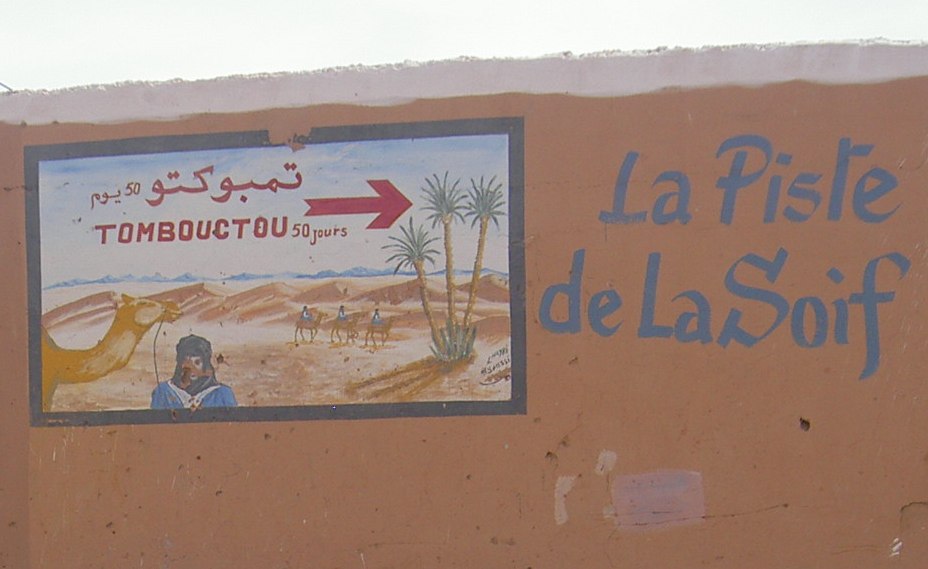
I started visiting Morocco in 1969 and I've been there over a dozen times since. At some point it can't just be about laying around Marrakesh, Essaouira, Tangier and Fes. So some years ago I set out across the Atlas Mountains south of Marrakesh and discovered Taroudant, which is kind of what Marrakesh was like in the 1960s before it became so cosmopolitan. I loved it and kept going back. From there we'd set out for Tiznit and even Sidi Ifni further south and east and then, eventually for Ouarzazate, Zagora south and west and even Mhamid right at the edge of the Sahara, the last stop before the 2 month camel ride to Timbuktu. I just saw the Cadillac ad above with the driver going through the Atlas Mountains at the Dadès Gorges. We did hire a camel driver and his son to take us out into the Sahara Desert... but not as far as Timbuktu, which we did eventually get to-- in a jeep. As for the curving passes of the High Atlas... oh yes; we did that, several times in fact. But once was a time I'll never forget. We weren't going nearly as fast as the Cadillac in the ad-- nor did we have nearly as good a vehicle-- but we were descending pretty briskly when... no more pavement. The asphalt suddenly gave way to gravel. You know what happens when the asphalt suddenly gives way to gravel? It had never crossed my mind 'til then either. But we spun right out of control and headed for one of those drops you can see in the Cadillac ad. In fact, the bottom of that gorge is filled with cars and trucks that did go over during the years. I'd like to say it was my reflexes and skillful driving that saved us-- and it may have been; who remembers anything but the sheer terror? But I think it was just luck. The car came to a stop an inch for the deadly drop. Within second a dozen old Berber men were swarming all over us, as though they came out of the sides of the rocky crevices. Each one wanted to touch my heart. For luck I guess.
Nothing much in M'Hamid but flies, sand and camels
It's very rare that I meet a Moroccan who has traveled more extensively through his country than I have. I started going there in 1969-- drove a van from Germany and went all over the country, from the northeastern kif-growing regions of the Rif down to Marrakech and Essaouira. After a dozen trips, I've long since lost count. But I've expanded my horizons and have traveled way south of Marrakech, from Tiznit and Sidi Ifni in the West to Ouarzazate, Zagora and M'Hamid on the edge of the Sahara sand dunes. And, yeah, we even headed out across the Sahara towards Timbuktu by camel... although we didn't get very far and eventually got to now-inaccessible, rebel-held Timbuktu a few years ago by jeep... from Bamako.
Anyway, I've been almost everywhere in the country and I really love it-- and always recommend it. And Morocco has always been especially alluring for bohemians, rebels, and misfits, including, of course, musicians. The first time I was in Essaouira it was with Jimi Hendrix. Many years later I was relaxing in the courtyard of an old friend in Tangier-- someone who had first introduced me to Gnaouia music-- when I realized that the courtyard was pictured in the Steel Wheels album. That's because they recorded part of it in 1989 right where I was sitting. But this weekend the Washington Post ran a story about musical trouble in the magic kingdom. With the Tuaregs in control of the Malian Sahara now, kidnapping tourists and enslaving anyone they can get their hands on, Morocco's music festivals aren't going to have any more competition from the Festival au Désert. But that doesn't mean it's all smooth sailing.
Morocco’s glittering Mawazine international music festival wraps up this weekend with performances by Mariah Carey and Lenny Kravitz, after nine days of showcasing the North African kingdom’s cool factor-- even as dissident Moroccan musicians are imprisoned for their anti-establishment lyrics.
The 11-year-old “Rhythms of the World” festival in the capital Rabat has always highlighted Morocco’s contradictions as the country spends millions to lure top world artists to perform at generally free concerts, while much the country remains mired in poverty.
In past years the festival has been attacked by Islamists for inviting gay performer Elton John in 2010 and by activists for the cost of attracting Shakira and other high profile acts in 2011, but this year the theme of protest is freedom of expression.
Just a week before the festival began, Human Rights Watch slammed Morocco for sentencing a rapper to a year in prison for lyrics deemed insulting to police-- a common theme in rap music elsewhere in the world.
“Morocco hosts one famous international music festival after another each spring, but meanwhile it imprisons one of its own singers solely because of lyrics and images that displease the authorities,” Sarah Leah Whitson, Mideast director of the group said in a statement. “Morocco should be known as a haven for world music, not for locking up singers with a political message.”
Moroccan rapper Mouad Belghouat, known as El-Haqed, or “The Enraged” was convicted on May 11 of “showing contempt” to public servants with his song “Dogs of the State” about police corruption. He is known for his political activism and vitriolic songs attacking social injustice, the monarchy and corruption.
A week later, dissident poet Youssef Belkhdim was convicted of attacking police-- a charge he denies-- at a sit-in he organized in support of Belghouat and sentenced to two years in prison.
The two men belonged to Morocco’s pro-democracy February 20 movement that last year brought tens of thousands into the streets protesting corruption and calling for political reform.
The extravagant sums spent on the Mawazine have been a mainstay of the movement’s slogans. Festival organizers maintain that the Mawazine’s estimated $7 million price tag is worth it because it improves Morocco’s image abroad and gives people at home access to music from around the world. The festival is funded largely by corporate sponsors with strong ties to the state.
“It’s a celebration. It’s a celebration of the city, a celebration of Morocco and it reflects a bit Morocco’s good life to the world,” said program director Mahmoud Lemseffer. “It is a vehicle to present the image of our country, of its hospitality and tolerance.”
Tens of thousands attend each of the festival’s eight venues which present Arabic music, Moroccan music, music from sub-Saharan Africa as well as international acts, which this year included Evanescence, the Scorpions, Gloria Gaynor, Nigel Kennedy and Jimmy Cliff.
Most of the acts have free sections open to the public and on Tuesday, families strolling along Rabat’s Bouregreg river stopped to listen to Beninian songstress Angelique Kidjo belt out classics from South African diva Mariam Makebe and talk about the struggle against apartheid.
But for critics, there is irony in punishing artists at home while hosting international ones known for their support of freedom of expression. Lenny Kravitz, for instance, has striven in song after song to confront America’s tortured attitude about race.
“I think that people should really say what they feel-- everybody has the right to speak their mind, you see how things change in places where people were once condemned,” said Kravitz at a press conference Thursday when asked about politics in music. “When I was in Brazil a couple of years ago, I was talking with (musician and activist) Caetano Veloso who dealt with that same thing, who did jail time-- and now he has made a difference.”
Salif Traore of the Ivorian band Magic System said that for African artists, speaking truth to power and freedom of expression is what their music is all about.
“We in Africa, we say that artists, musicians and singers are the eyes, ears, and mouths of the people,” he told The Associated Press, when asked about his views on the El-Haqed case.
Rachid el-Belghiti, who heads a national anti-Mawazine campaign, also contests the government’s assertion that it’s supporting culture in Morocco with this festival, countering that it’s really just about making the country look good abroad.
He said the Mawazine, which is run by a close confidant of King Mohammed VI, eats up the lion’s share of corporate sponsorship so that little is left for other festivals around the country.
As millions are being spent to lure in big name acts, local theaters and dance schools around the country are closing down because of a lack of funding.
“A country which puts its artists in prison simply for expressing themselves with their voice or their instruments cannot pretend to support culture,” he said. “That’s impossible.”
And, by the way, the Rabat music festival is totally commercial and strictly for squares and the one-percent. The hipster festivals are the Gnaoua World Music Festival in Essaouira and the newer Festival des Musiques Sacrées du Monde in Fez. When the king is finally overthrown, the last bastion before he flees to one of his European estates will be Rabat.
In the past I've always maintained that Morocco is a wonderful and safe place for tourists to visit-- and I've been there over a dozen times, starting in 1969. The post linked above is from 6 years ago. Lately I've come to the conclusion that it's still wonderful, of course, but not quite so safe. Nowhere in the Middle East/North Africa region is. Last time I was there, this past December, I rented a riad in Marrakech, one of Africa's most cosmopolitan cities. Yesterday my friend Helen alerted me to a terrorist attack aimed right at the heart of Moroccan tourism.
In Marrakech all roads lead to the Jemma el-Fna, the main square of the old city, and no matter where you're going in town, you start and you end there. Even distances are measured from how far it is from the square. It's been crawling with tourists-- sometimes thousands and thousands of them-- for decades, if not centuries. The cafes that line the sqaure may not serve the best food in town but theey're the most popular because of their locations and their rooftop terraces. I suspect there'll be a lot of people canceling their reservations now.
A massive terrorist bombing tore through a tourist cafe in the bustling heart of Marrakech's old quarter Thursday, killing at least 11 foreigners and three Moroccans in the country's deadliest attack in eight years.
At least 23 people were wounded in the blast a few minutes before noon in Djemma el-Fna square, one of the top attractions in a country that depends heavily on tourism, Moroccan Interior Minister Taib Chergaoui said.
Government spokesman Khalid Naciri told the AP it was too soon to lay blame for what he called a terrorist attack but he noted that Morocco regularly dismantles cells linked to al-Qaida in the Islamic Maghreb and says it has disrupted several plots.
At least eight French citizens were being treated at Marrakech's main Tofail Hospital, along with one Canadian, a British citizen and three Moroccans, emergency room chief Hicham Nejmi said. Others were being treated at a military hospital and a handful in private clinics.
April marks the start of Morocco's tourist season, when visitors gather to watch snake charmers, storytellers, jugglers and local musicians, filling the cafes that ring the edges of the iconic square on the route to the city's major open-air souk, or market.
Death toll has grown to 16 now. We'd eaten at the Argana several times, mostly because it was a place to hang out to watch the circus that is the Jemma al-Fna. There are half a dozen other places just like it. Moroccans are determined to kick out the plutocratic old regime. It's going to be very painful. There couldn't have been a more effective way than this to deal a major blow to Morocco's economy.
4 months ago Helen took this photo of our friends Mieke and Toon on the Argana terrace, where the bomb exploded this week
UPDATE: More Trouble Brewin'?
The pressure's definitely on and I'd think twive before booking tickets to Morocco any time soon. Today Hisham al-Miraat, co-founder of Talk Morocco, posted a warning at Foreign Policy called Showdown In Morocco. Short version: the Arab Spring is turning into an Arab Summer and it could get pretty hot.
The makhzen refers to an ancient institution in Morocco-- the extended power apparatus close to the Moroccan monarchy, made up of a network of power and privilege. It allows the King to act as an absolute monarch and the de facto head of the executive. Beneath the give and take of everyday politics, the makhzen has always been the ultimate guarantor of the status quo. For three months, the pro-democracy youth movement, known as "February 20," has been advocating against that status quo. Protests have not been targeting the monarchy directly, but instead have been urging for reform that would yield a system in which the King reigns but does not rule.
What started as a small group on Facebook earlier this year, has since grown into a nationwide movement made up of a loose coalition of leftists, liberals and members of the conservative Islamist right. Inspired by the Tunisian and Egyptian uprisings and powered by new media, the movement convinced hundreds of thousands to take to the streets. The demonstrations held week in, week out, were remarkably peaceful. In response, King Mohammed VI promised a package of constitutional reforms to be submitted to a referendum in June. But as protesters, unconvinced by the King's promise, vow to keep up pressure on the regime, authorities seem increasingly impatient and determined to break up protests violently, paving the way toward escalation and confrontation with the street. The middle class is joining the mass of demonstrators, moving the protests beyond the core of mobilized youth. Their target is the makhzen-- which has become a code word for the monarchy's abuses of power and monopoly over large sectors of the economy.
...[O]n April 28 a terrorist bomb attack hit a popular restaurant in the heart of Marrakech, killing 17 people. The country was plunged into a state of shock. Beyond the unanimous condemnation, the timing of the attack raised many questions. The fear of a security clampdown and a freeze of liberties were the main concerns of pro-democracy advocates. Their fear is justified. The makhzen has traditionally actively sought to nurture an image of stability-- an exception to the turmoil in the Arab world. That strategy has worked for a time for the regime: Morocco is routinely praised by western officials as an ally of the West in a rather hostile region. The country holds an advanced status with the European Union; it has signed a free trade agreement with the U.S.; it is actively cooperating with the Americans in their global "War on Terror," and it enjoys the status of a Major Non-NATO Ally. The specter of terrorism has long been a useful card for gaining external support.
Police violence in recent days has escalated. On May 15, peaceful demonstrators who wanted to protest in front of an alleged secret detention center in Temara (dubbed Guan-Temara by protesters) near the capital Rabat faced repression. A week later, anti-riot police systematically and violently disrupted peaceful gatherings in public squares. This may be the sign that the regime is shifting its attitude toward the street and taking a much more hardline stance. As with other Arab regimes, the makhzen faces a dilemma: if it clamps down hard on peaceful protesters, it risks loosing its reputation as a model of democratic reform in a region often perceived in the West as averse to the liberal ideals of democracy. If it loosens up, then it will have to face the challenge to its own existence posed by a determined and organized street.
The "February 20" youth movement is vowing to keep up street pressure, rejecting the King's offer of token reform. If the regime insists on denying the people their rights of assembly and free expression, then the country will be heading toward the unknown. Against the backdrop of the Arab revolutions, change looks inevitable. It is still in the power of the monarchy to ensure a peaceful transition and at the same time ensure its own survival. The more the makhzen drags its feet, the more it runs the risk of undermining the stability of the country and, at the end of the day, its own existence.
Things are beginning to come to a head in Morocco's big cities as the monarchy takes off the gloves and prepares to kill anyone and everyone who wants to change the system. The corrupt regime will fall but it will be very bloody.
Arizona tourism went into the crapper as soon as violent extremists started running around the state with hate messages and unrestricted guns. Even Frommer warned the state is too dangerous to visit. I know Wisconsin is a popular tourist destination year round and I'm not sure if the right-wing turmoil in Madison is having any impact on the state's tourist industry-- not to mention the fried cheese curd and bratwurst makers. But some of the other areas where people are fighting for the human rights and dignity-- like Libya, Bahrain and Tunisia-- the tourist industry is dead in the water. Wikipedia's Libya Travel site starts with an ominous-looking warning sign: "WARNING: As of February 2011, Libya is in a severe state of political and civil crisis. Military, police and security forces are using deadly force in attempts to quell civil unrest in many parts of the country. Reports have emerged of thousands of people having been killed or seriously injured. If you are already in Libya, stay away from large public gatherings and try to gain independent and reliable information about the political and civil situation in your area. Try to organize a secure exit from Libya by contacting your country's embassy or their representatives either in Libya, your home country or neighbouring nations. The governments of many nations have issued formal travel warnings, research these warnings in depth before travelling to or moving about within Libya. Many nations have also recommended their citizens in Libya should leave the country immediately and some have managed to arrange evacuation flights or other means of travel. The situation is highly volatile, care and elevated situational awareness must be exercised at all times if attempting to move about or transit through effected areas of Libya." Not very alluring-- and a disaster for the country's small but developing tourist industry.
Morocco's tourist industry is far more developed-- and a crucial part of the country's economy. Tourism is way down as Europeans-- forget Americans-- wonder if the country is safe or likely to be the scene of violent protests like the rest of the Maghreb.
As the Egyptian and Tunisian destinations were collapsing, travel agents all over Europe were offering Morocco and the Canary Islands as alternatives for cancelled trips.
In Germany, Europe's greatest market, travel agents in late January and early February openly campaigned for Morocco as the safe and quiet alternative to Tunisia and Egypt in local media. Similar campaigns were registered in the UK, Scandinavia and France.
Consequently, flights to Morocco from Europe over the last few weeks have been fuller than ever during a low season. Morocco today published record arrivals for January, and the growing Moroccan tourism industry was making important extra revenues.
But these short heydays are now over. Each and every day, international media are overflowing with reports from the protest wave spreading to new countries. There is a widespread impression it is only a question of time for unrest and revolution to reach Morocco.
An American tourist spends something like 8 times what other tourists spend... and Americans have been the first to cancel their trips to anyplace remotely dangerous-sounding. Even now, with Europeans beginning to trickle back into Egypt, Americans are booking trips to Hawaii, Las Vegas and Bermuda instead.
Egypt earns upwards of $13 billion a year from its tourism industry -- an integral part of the nation's struggling economy.
But Masood Ahmed, director of the International Monetary Fund's Middle East and Central Asia Department, told a press conference last week the decline in tourism was likely to seriously hurt Egypt.
"The recent popular protests in Egypt will definitely have a short-term economic cost," Ahmed said. "We will see tourism and investment going down, and certainly the 5.5% growth rate that we saw in the last two quarters of 2010 will likely be considerably lower in the next six months."
And that decline in tourism isn't likely to change anytime soon. The U.S. State Department is still warning Americans to stay away from Egypt for "non-essential travel."
"Due to continuing uncertainties regarding the restructuring of Egyptian government institutions, the security situation remains unresolved," the department said in a travel warning posted on its website. "Until the redeployment of Egyptian civilian police is fully restored, police response to emergency requests for assistance or reports of crime may be delayed."
The U.S. government has also ordered the departure of all nonemergency personnel from Egypt. Cairo is one of the largest duty stations in the world, with thousands of U.S. employees administering economic and military aid.
But British Prime Minister David Cameron visited Egypt this week-- and his government is allowing British tourists to return to Sharm el-Sheik and the Red Sea resorts. So has Germany's government.
Many tourist sites in and around Cairo are open again-- from the pyramids to the Khan el-Khalili souk to the Egyptian Antiquities Museum. But these days the most sought-after photo is not one of Tutankhamen’s mask but of Tahrir (Liberation) Square, a mammoth traffic circle the world had stared at for three weeks on television. Named after Egypt’s 1919 liberation from the British, Tahrir Square is a top destination for many of the Western tourists who have begun trickling into Egypt in recent days.
“It is amazing what has happened here,” said Aart Blijdorp, a 60-year-old civil servant from the Netherlands. He had flown in a few days earlier to attend the seven-day anniversary of Mr. Mubarak’s resignation, a gathering on Tahrir Square that the protesters hope will become a weekly Friday event to remind the current military government of their continuing demands for reform. “The optimism in the air was so apparent on the news, I had to come feel it for myself,” Mr. Blijdorp said, after introducing me to two young protesters he had met in the square. They had become Mr. Blijdorp’s tour guides around Cairo.
“We have been taking him around because he is traveling on his own,” said Omar Ahmed, 23, a civil engineer, adding that they were off to the Citadel, but that Mr. Blijdorp wanted to come back to Tahrir Square first.
“The good news is he is seeing everything fast, because no one is here,” said Hamdy Mohammed, 24, a law student. “But we want tourists to come back because it is a new Egypt now.”
“So far, Tahrir is my favorite place,” said Mr. Blijdorp, who had visited the Pyramids the day before.
The allure of visiting Egypt at this moment hasn’t been lost on some tour operators. For example, Akorn Destination Management (akorndmc.com), which bills itself as an organization that delivers “inspirational travel experiences,” is offering “Tahrir Square-- Egypt Is Making History,” a trip that includes a Nile cruise, a walk through Tahrir Square and a stay at the Semiramis InterContinental Hotel, which is near the square.
As Rick Zeolla, the general manager of the Cairo Marriott, where Christiane Amanpour and many other journalists stayed, put it: “Right now Egypt is like having a fast pass at Disney. People should come over.”
Amr Badr, managing director of Abercrombie & Kent in Egypt and the Middle East, believes now is a unique time to visit Egypt and see history in the making. “I think people will immediately feel the energy,” he said, noting that the streets are now cleaner than they have been in recent memory, and that Tahrir Square has become a “living exhibit-- a sort of Speaker’s Corner” in Egypt that they plan to promote. Egyptians, he added, are feeling a newly found sense of pride in their country. “If Egypt was good before, it will be better now,” he said.
Michael Koth, general manager of the Semiramis InterContinental, said his clients are no longer asking for a “Nile view” room but a Tahrir view. “The early guests we are seeing are more independent, well seasoned and globally focused travelers,” Mr. Koth said.
Mali was probably more "dangerous" when nothing was especially going on, politically speaking. Here below is a photo I took of Roland on rue Guide Mouamar El Kaddafi in Timbuktu. Last week we were in Guadalajara, right after a terrorist attack that left nearly 50 people dead or wounded. Everyone we knew told us not to go. Yet the place seemed safer than New York or L.A.-- and the prices were down and the crowds much smaller, making everything easier. We love Guadalajara anyway, but it was even better with all the wooses scared off. Nothing would get me to Libya 'til the Qaddafis are dead-- which could be weeks away-- but we're already thinking about a trip there soon. Arizona... not so much.
This morning many eyes turned nervously towards Jordan, where King Abdullah, reacting to demonstrations blaming government corruption for high food prices and a horrifying standard of living disparity between the rich and poor, fired one tool (Prime Minister Samir Rifai) and replaced him with another (Marouf Bakhit, a military guy). But it is more likely that the next explosion, in the wake of Mubarak's regime collapsing, will be further west along the Mediterranean, Morocco.
I hope I'm not boring everybody with all the talk about Morocco, which, I realize, most Americans haven't been terribly aware of after it became the very first country in the world-- yes, even before France-- to recognize our revolution and our independence from the tyranical British superpower (December, 1777). I first went there is 1969 when I was just a kid and I've been writing about it ever since. I lost count of how many times I've been there after a dozen and I've yet to meet a Moroccan who's been to as many places in Morocco as I have. (I can always pull Sidi Ifni or the Erg Chigaga dunes south of M'hamid out of my hat.) I just spent most of December in Marrakech, where I rented a riad next to King Mohammed VI's palace in the medina. Most of the traffic that comes to thisl blog comes from people on search engines who find the post Is Morocco A Safe Place To Visit?. The short answer to the question about Morocco being safe is YES. But in light of the revolutionary spirit coursing through the Arab world, especially in North Africa, we need to take a look again. Can tranquil, scenic, touristic, ever more cosmopolitan Morocco go the way of Tunisia and Egypt? Short answer is the same: YES!
I didn't want to be rude to the neighbor but, like I wrote, Mohammed VI, when you strip away the 21st Century p.r. veneer, is an authoritarian despot, not all that much different from any king or Emperor or sultan or tsar. In fact, one thing I noticed a lot-- and eventually started questioning people about-- is that many Moroccans sounded exactly like pre-Revolutionary Russians believing in only their Little Tsar knew what evil the terrible men around him were perpetrating against his people! Mohammed calls all the shots in the family business, a business that owns at least a piece of almost everything, from the big hotels to the drug trafficking bonanza that a Wikileaks cable from a U.S. diplomat asserts is the only bigger source of income in the kingdom than the tourist industry. And remember, it was the release of wikileaks cables that opened the flood gates against the dictators in Tunisia and Egypt as well.
Even members of the royal family believe Morocco's monarchy can't go unscathed by what is sweeping the rest of North Africa right now. The King's cousin, Prince Moulay Hicham, 3rd in line to the throne and popularly known as the "Red Prince," because of his criticisms of the monarchy, said "the political liberalisation launched in the 1990s after Mohammed succeeded his authoritarian father Hassan II had virtually come to an end, and reviving it while still avoiding radical pressures would be 'a major challenge'." Everyone is counting on the spiritual bond between THE KING and the people, a bond, they hope, makes him different from a grubby usurper like Ben Ali or Mubarak or Algeria's Abdelaziz Bouteflika. On the other hand, dissident journalist Aboubakr Jamai wrote in France's Nouvel Observateur that "If Morocco goes up, the disparities in wealth are such that the rebellion will be much bloodier than in Tunisia."
Afrol News appears to be as anti-monarchial and "down with tyranny" as we are here. This week, with Egypt exploding, they seemed to try stirring things up a little for Mohammed who, they reported, was off in one of his fabulous palaces... in France, plotting, no double, contingencies in case any radicals decided it was time to follow the example of Tunisia and Egypt and throw off the chains of oppression and kleptocracy.
Discontent is ample in Morocco, the poorest, least developed North African nation, and many are inspired by developments in Egypt. Meanwhile, Morocco's King Mohammed VI rests in his French luxury chalet.
Morocco so far has been spared from larger protesting groups as those in Tunisia and Egypt, much thanks to the King's quick reversal of boosting prices for basic foods. The same move proved a good assurance for authorities in neighboring Algeria.
But discontent is very widespread in Morocco. Despite an economic boom over the last years and some careful reforms ordered by King Mohammed VI-- most prominently regarding gender equality and education-- Morocco remains the poorest country in North Africa, with least employment opportunities and the lowest literacy rate.
The King, claiming to descend from the Prophet Mohammed, has an almost divine role in Morocco. Very few dare to criticise him, even in the mildest form.
Among the Arab majority, loyalty to the King is great, while the government-- appointed by the King-- and age-old ruling "Makhzen" class-- controlling the administration, police, army and much of business-- are the popular focus of hatred. In the streets of Casablanca, it is often said that the King is honest and wants to rule the country well, but the Makhzen is corrupting everything.
Minorities, however, to a wider degree dare to blame the King for their mischief. This includes large parts of the indigenous and disadvantaged Berber people. Estimates of the Berber population wary from 20 to 60 percent of the Moroccan total, with official estimates being the lowest. Unemployment is highest among Berber youths, of which many view the Arab King as a foreign imposer.
...As the tourist market in all North Africa now is crumbling-- many travellers fear Morocco could be next-- the kingdom's greatest growth and employment sector could soon be strongly impacted. A sudden growth in unemployment due to falling tourist arrivals could spark revolt.
Blogging from Fes, Matt Schumann is a Fulbright Scholar and English teacher at the S.M. Ben-Abdellah University, a graduate of Rice University and an incredibly well-informed and very perceptive observer of the Moroccan street, far more so than anyone you're going to ever hear on the utterly clueless CNN or the ideologically sociopathic Fox News. Last week he wrote about being in Morocco and watching the Moroccans watch the developments unfolding in Egypt. His conclusion, though, is that Morocco is immune to the upheavals sweeping the Arab world. I disagree but I want to offer his arguments, since they make a great deal of sense and include important information we'll need to look at when the revolution does, inevitably, come to Morocco.
It's been strange to be in Morocco during all of this. There's no lack of information. When you walk into a cafe, people are watching coverage of Egyptian protesters burning police vehicles or tearing down posters of Hosni Mubarak. But these images and ideas don't seem to be penetrating. A glance through two of the biggest newspapers, As-Sabah and Al-Masa', lead you to believe that the protests are only tangentially relevant to Moroccans. There are no attempts to apply Tunisians' and Egyptians' grievances to a Moroccan context. On Facebook, my students have posted pictures of the Egyptian protesters along with words of support and solidarity, and then proclaim their love for Morocco's King Muhammad VI. How can you identify with the protesters of two revolutions against authoritarian governments and still do that?
Why have the events in Tunisia and Egypt failed to generate the same reaction in Morocco as they have elsewhere in the Arab world?
Reading reports from the past weeks has made it clear to me that life for the average Moroccan is very different than that of a Tunisian or an Egyptian. Yes, Morocco is a poor country with high unemployment. The GDP per capita is significantly lower than Egypt's and nearly half that of Tunisia. Yet, the poverty is not oppressive. Life necessities are cheap in Morocco. People are poor but do not starve. The Moroccan government also tolerates "underground economic activities" which provide money and support for many young, uneducated Moroccans. The most notable of these is the drug trade, which according to WikiLeaks, generates more money than tourism, the largest sector of the Moroccan economy.
A second, key difference, concerns education. As one commentator pointed out, Tunisia is an exception in the Arab world in that it has a large, educated middle class. The middle class' dissatisfaction with the country's economic prospects fueled the protests that eventually led to Ben Ali's downfall. Egyptians, while not nearly as wealthy as Tunisians, are similarly educated. Both countries post literacy rates in the 70s and both protests movements have utilized social (especially Tunisia) and print media (especially Egypt) for organizational purposes. Morocco is a completely different story.
At best, 50% of Moroccans are literate and many well-educated Moroccans are ex-pats living in Europe or North America. While this may seem insignificant, I think it's a huge factor. Moroccans' illiteracy hampers the spread of information in general, and would definitely impede the organization of any type of protest movement. Additionally, the Moroccans who identify the most with Tunisia and Egypt don't live in Morocco. They've already exercised their discontent by leaving the country... [T]here is no credible opposition to the King [inside Morocco].
Morocco is a parliamentary monarchy that has a prime minister, political parties and elections. But in reality, it's something else. Parliament and the lesser bodies of government are where corrupt officials take bribes and appoint their sons- and daughters-in-law to influential posts. This corruption is obvious and derided by the Moroccan people. It's not uncommon for a Moroccan to say that the best way to make money in the country is to get into politics, but that you can only do that if you know the right people.
The King is seen as the only credible member of government despite his overwhelming and unquestionable political powers. And there's good reason for this. Royal initiatives, like infrastructure development and some social reforms, are completed on time and relatively efficiently. In other words, he gets things done when other Moroccan politicians don't. Combine that with the legacy of the Alaouite Dynasty, which has ruled Morocco for nearly four hundred years, and Muhammad VI is seen less as a despot and more as a benevolent and beloved monarch.
Now it's true that the King has the power to end the corruption that plagues parliament, the police and the military. Allowing his political opponents to profit in their subordinate positions decreases their desire for change. Additionally, their corruption draws the ire and attention of the people. So while his policies may leave something to be desired in the eyes of some Moroccans, the alternatives are much much worse.
The commentator who describes Tunisia as an exception in the Middle East may be eating his words in the next few days depending on Egypt's outcome. This doesn't mean Moroccans are happy with the state of affairs in their country. Poverty, unemployment, education, and political freedom are just a few issues that Moroccans feel must be addressed. But for now, the situation does not seem dire.
More than anything, Moroccans love stability. This is why they love the King. They tolerate the political and social status quo because it still meets their needs and because they don't have to worry about what tomorrow will bring. Because of this mindset, I don't think radical change is anything many Moroccans feel is necessary. Speaking to a Moroccan friend he said that while things here are not good, they are getting better. "Maybe five or ten years from now, but not now," he added. As long as this attitude persists, Morocco will stay stable.
Everybody loves stability. But it costs Morocco and awful lot to keep the king-- much more than he's worth, not just in my estimation but in the estimation of more and more people. When Egypt falls and things get ramped up in another country, Mohammed VI is going to be very happy his family's corporation has all the billions of dollars they've stolen from the people of Morocco separate from the state's funds. Like the rest of the kleptocrats, they and their spawn will be living on it for generations-- in other countries.
I stopped using drugs decades ago. But Saturday I could have used some to start 2011 off on the right foot. I didn't have any, though, and I found a fine substitute, courtesy of Apple-- the new iPod, which is the size of a matchbox, only way thinner. The day started off dreadfully enough in London. I had a flight out of Heathrow at noon but I had noticed the night before that the city had just closed down all the main thoroughfares in the West End to muck things up on New Year's Eve. I had a feeling that the parade-- basically for Russian and French tourists-- on January 1 was going to also be a traffic mess. I was right. I thought the best chance I had of avoiding it would be to leave early. I was out of the hotel at around 7AM-- pitch black, freezing, wet though not raining... and all the streets around the hotel already closed to traffic!
I have a terrible cold I picked up from one of my friends in Morocco and I was a mess-- a mess who had to walk a mile to find a street with traffic and a taxi to get me to Paddington Station and the Heathrow Express. I had a 20 pound note. Paddington should be half that. Turns out the taxis have a 4 pound New Year's Day surcharge. I still made it on budget-- with enough left over to buy a couple of packs of tissues for the plane. The plane, of course, was late leaving and the two new B.A. business lounges in Terminal 5 are not very impressive-- unless the goal is to remind business travelers that there really is a big difference between flying first class and flying business class. Anyway, there were long lines that didn't seem to move everywhere and I was getting jittery. That's when I realized that my music would brighten me right up, the way drugs might have when I was in my late teens. And did it ever. I was soon singing and dancing, entertaining myself and everyone around me. Blink 182, Jesus and Mary Chain, Frank Sinatra, Black Eyed Peas, Bodeans, Libertines, Offspring, Andrea Bocelli, Depeche Mode, Sisters of Mercy, Velvet Underground... The battery ran down while I was waiting for my luggage at LAX. My bag was among the first half dozen to come down the carousel and life was good.
People were still getting off the plane when I was already in a taxi on my way home to a nice, long steam shower. L.A.'s "freezing," people say. It's 60. In London it was in the 30s. There's a difference, a big one. London's already a memory, although I just downloaded some photos Roland and I took of each other at the Tate Modern on Friday. Here I am in front of a triptych by my very favorite artist:
And here's Roland in front of a painting by Cy Twombly, who he really, really hates:
I know I'm always ragging on what a crap airline Delta is. But I have a new nominee for worst airline ever. Roland reminded me of how dreadful Timbuktu Air and Mali Air both are. On one of them a guy got on the plane with a gigantic sword and there was a big brouhaha over whether he could carry it or not. In the end a compromise was worked out. He handed it over to the stewardess, who gave it back to him after we took off. India's Sahara Air was even worse. They were selling standing room and the restrooms were filled with boxes of TVs and items like that that the crew was transporting for themselves. But Royal Air Maroc, considered one of the best airlines in Africa has got to be 2010's pig-in-the-poke. We've flown it back to various European cities in the past and never noticed how really bad it is. This time we did. And so did everyone else we talked to about it.
Back in the U.S. before the trip began they arbitrarily changed Roland's flight from Marrakech to London, meaning we wouldn't be flying together, even though we bought them at the same time with the same credit card. We called their 1-800 number dozens of times. No one ever answers. Never-- no time of the day or night. I asked my travel agent to try. He confirmed my experience. Royal Air Maroc doesn't take phone calls-- nor do they answer e-mails. Everyone in our party had bad experiences flying into Marrakech and in one case, home to the U.S. I'm guessing though that the cockroaches didn't mind.
Royal Air Maroc deteriorating customer service has resulted in some unexpected types of passengers on board lately, cockroaches. These critters do intermingle with passengers in search for food, as shown in this video, and customers were forced to play exterminators. Customers have complained for some time that unless Royal Air Maroc recruits its personnel based on merit and not on nepotism, and works to instill work ethics in its work force, where good work is rewarded and mediocrity is punished, it will not realize its potential and become a trusted international airline with Casablanca as a major hub.
An analyst, M. Zakaria, said "Royal Air Maroc prices keep going up while its service continues to go down. On the topic of high fares, Royal Air Maroc management's mistakes are causing the high fares and accentuating bad service.
RAM made four major mistakes. The labor agreement with their pilots, the bad investment especially when they purchased Air Senegal and also starting low budget airline, Air Atlas (A flagship airline should not be in low cost business) and lastly the high price of Fuel (RAM pre-payed for the fuel back when the barrel was almost $100). So the customers are paying for RAM mistakes.
RAM pilots are amongst the highest paid pilots in the industry. They average is about $100K/Yr where as EasyJet, Jet4U and Air Arabia pilots make less than $40K/Yr. It's not just the pilots that are burdening Royal Air Maroc overall payroll, their higher Managers are also getting paid higher than average. So RAM need to charge more to pay the high salaries/benefits. Shipping with Royal Air Maroc is also problematic, their Cargo business has been in the red for many years.
I never begrudge working people decent salaries-- even though the landing in Casablanca was one of the worst I had ever been through. But I did watch the cargo being unloaded and it absolutely looked like the cargo handlers were competing with each other over who could break the most stuff. I should mention that the stewards on the flight from Casablanca to London were very professional and solicitous and that even the food was decent.
Last week our next door neighbor in Marrakech moved back into his place. He has homes all over Morocco and goes from one set of digs to another. There seem to be two or three just in Marrakech. He was here a couple weeks ago for the Marrakech Film Festival and I'm not sure why he's back so soon. I don't expect to see him-- other than on TV-- and I only knew he was back because of the huge number of heavily armed troops on every street and alleyway in Sidi Mimoun, our quiet little neighborhood. I had just been reading about him, thanks to Wikileaks.
You probably know me as a critic of conservatives but if you want to see me really get going, just start talking about monarchy. One of the highlights of the month was the video I saw of British students attacking the limousine of Queen Elizabeth's reactionary son-- purportedly the next so-called "king" of England-- and the ho he's shacking up with. The students were chanting "off with their heads," music to my ears.
But these immensely wealthy and powerful royal families are extremely committed to holding onto their positions at the tip-top of society-- and extremely dangerous. My friend Toon arrived in Marrakech a few days ago and he happened to tell me about how the journalists involved in the exposure of Prince Bernhard of Lippe-Biesterfeld as a Nazi were ruined and professionally destroyed. Bernhard, like England's weak-minded King Edward VIII, was a Nazi who conspired, in Edward's case, at the urging of his American Nazi wife, Wallace Simpson, with Hitler to bring fascism to his country.
[W]ith a belligerent new leader in Berlin threatening to rip up the Treaty of Versailles, those [Nazi] sympathies posed a serious problem-- particularly when King George V died in January 1936. Edward inherited the throne as a hugely popular new king-- and set about meddling in government policy. This was in defiance of all convention but that didn’t stop Edward. He took to calling the German ambassador directly-- a clear breach of constitutional protocol and one with serious practical consequences.
When Hitler made it clear he meant to send his forces back into the demilitarised Rhineland the government expressed its opposition. Edward should have stepped back. Instead he threatened to abdicate if Hitler’s advance was stopped, compounding the harm by phoning the German ambassador to tell him he had done so.
“The reassurances from Edward that Britain wasn’t going to fight were crucial,” says Professor Jonathan Petropoulos, author of Royals And The Reich. “Hitler had an ace in the hole, as we would say in American poker, knowing what he did from Edward at the time.”
In that context the abdication at the end of 1936 came as a godsend to the government. But even off the throne the Duke of Windsor posed an ongoing problem.
The FBI files show that at a party in Vienna in June 1937-- the month he married Mrs Simpson-- the loose-tongued Duke told an Italian diplomat that the Americans had cracked Italy’s intelligence codes.Four months later the Duke and Duchess paid a high-profile visit to Germany where the Nazi regime fawned on him. They met Hitler, who saw the value of cultivating an ally once so intimately involved with British affairs. Nazi propaganda chief Joseph Goebbels wrote of the Duke: “It’s a shame he is no longer king. With him we would have entered into an alliance.”
Even the declaration of war was not enough to make the Duke sever his Nazi connections. He was made a major-general and stationed in France but he continued to communicate with the enemy. In January 1940 the German minister in The Hague wrote that he had established a direct line of contact to the Duke.
This line of contact proved crucial to the tragic fate of France. From the Duke the Germans learned that their plans for the invasion of France had fallen into Allied hands. This intelligence allowed Hitler to change his plans and catch the Allies by surprise. France fell.
The FBI papers also reveal that the Duchess of Windsor was in regular contact with the Nazi foreign minister Joachim von Ribbentrop, whom the Americans suspected of being her former lover. After the fall of Paris she and the Duke hopped from Biarritz to Madrid to Lisbon, shamelessly consorting with wealthy fascist sympathisers.
In Portugal Edward committed what may have been the worst act of his shabby career. In July 1940 the German ambassador in Lisbon passed a message to Berlin saying: “The Duke believes with certainty that continued heavy bombing would make England ready for peace.”
The former king was urging the bombardment of his own people.
Prime Minister Winston Churchill understood the danger he posed and was desperate to get him back to Britain, at one stage threatening him with court martial if he refused. In the end sending him to govern the Bahamas-- a humiliating posting which both the Duke and Duchess detested-- proved the most viable option.
But as Fulton Oursler was to discover the former king continued to plot from the governor’s mansion in Nassau, driven by a combination of his own Nazi sympathies and his belief that a strong Hitler could help him back to the British throne.
Shortly after he took up the post the Duke told one confidant: “After the war is over and Hitler has crushed the Americans we’ll take over. The British don’t want me as king but I’ll be back as their leader.”
Bernhard's p.r. machine always went to great lengths to portray him as a war hero and anti-Nazi fighter. But it was long whispered in Holland that the husband of one queen and the father of another, was a filthy Nazi traitor, member of the SS, and a member of the Nazi Party just before he married Crown Princess Juliana.
Back to my neighbor, Mohammed VI. He wasn't even born until 1963, long after Hitler killed himself. He became king in 1999 when his father Hassan II died and everyone says he's far more popular than his father. He inherited at least $2 billion but is said to have a piece on almost everything in the country. I have no way of knowing if that's true or not but I did notice another Wikileaks document that tarnishes Mohammed's patina pretty disastrously. Seems one of the things he has "a piece" of is his country's narcotics trafficking.
For the first time a U.S. official document speaks of the involvement of Morocco in matters of drug trafficking, citing officials of the Moroccan police working at Casablanca airport, who have been sanctioned in mid-August 2009 after they had arrested the son of the Senegalese president and the son of a Minister of the same country for drug possession.
• According to the report, King Mohammed VI had not appreciated the arrest of president's son and a Senegalese minister’s son without his knowledge and without prior consultation. The two Senegalese were released later and the police officers punished.
• The report also quotes an official of the Moroccan police in Casablanca, who was mutilated in the occupied city of Laayoune after he had implicitly accused the regime of being behind the drug mafia.
• Another report published by Wikileaks dated 2008 talks about the corruption that plagues the Moroccan army, especially among senior officials of the military institution. It says "the Moroccan army suffers from corruption, bureaucracy, lower educational level of officers and the continued threat of extremism of some elements." It added that "the head of the gendarmerie, General Hasni Ben Slimane "allegedly involved in corruption cases."
• Corruption, the report said, plagues the top military hierarchy in Morocco and General Benani turned into "a Baron of milk." the latter, taking advantage of his position as army chief in the occupied Western Sahara, manipulated markets to supply the army in milk, thereby making a fortune in billions of dollars, in addition to his involvement with other generals in doubtful markets of fishing permits on the coast of Western Sahara. He managed well, the report said, to build a palace for his family with money of corruption.
• Corruption also affects the officers who, to qualify for promotions, pay bribes to their leaders.
The Guardian reported earlier this month that the king's holding company, Omnium Nord Africain (ONA), "extracts bribes and concessions from real estate developers," something that no one familiar with Morocco would be surprised to hear.
Morocco's royal family is using the institutions of the state to "coerce and solicit bribes" in the country's lucrative real estate sector, according to a leaked report from American diplomats.
Information about high-level corruption involving the rulers of Washington's closest ally in north Africa was brought to the attention of the US consulate in Casablanca, Morocco's commercial capital, by a businessman in 2009, leading diplomats to describe "the appalling greed" of those close to King Mohammed VI.
According to the US report, decisions involving Omnium Nord Africain (ONA), a holding company owned by the king, are made only by the king and two of his powerful associates. "To have discussions with anyone else would be a waste of time," the head of the company is quoted as saying.
Royal involvement in business is a hot topic in Morocco but public discussion of it is sensitive. The US embassy in Rabat reported to Washington in a separate cable that "corruption is prevalent at all levels of Moroccan society."
Mohammed, who succeeded his father, Hassan, in 1999, is said to have cleaned up the royal family's act, but it appears he has not done enough.
"While corrupt practices existed during the reign of King Hassan II … they have become much more institutionalised with King Mohammed VI," one cable quotes a businessman as saying. Institutions such as ONA-- Morocco's largest conglomerate, which clears most large development projects – regularly coerced developers into granting beneficial rights to ONA, the businessman was quoted as saying.
I should add that almost every Moroccan I've spoken to says Mohammed VI is way better than his father, Hassan II, and that he's doing a lot for Morocco, even if he's also doing a lot for the family business. One guy I met even told me he can't blame the king for undermining Morocco's educational system-- illiteracy is still gigantic-- because how would anyone expect a monarchy to hand on to power if the populace was well educated.
Roland and I were in shock yesterday when we walked into Essaouira. It has turned into a badly developed tourist hellhole almost on a level with Antalya in southern Turkey. Both of us tend to not buy into the constant carping by westerners that everything was better before and that all the favored places around the word have been changed for the worse. We've been scoffing at that widely held notion about Marrakech, which is still wonderful-- even if more overrun with tourists than ever before. But Marrakech is a big city with the capacity to gracefully absorb the kind of change massive tourism brings. Essaouira is a small town with less than 100,000 people. We looked around and said goodbye-- a once favorite place we won't be visiting again.
I was there for the first time late in the summer of 1969-- at the same time as Jimi Hendrix's short but legendary visit. It was sleepy and charming and I fell in love with the town. Since then no trip to Morocco was ever complete without a stop in Essaouira and I've recommended it to everyone going to Marrakech. It's a 3 hour drive and now they even have an airport.
Our last visit was in 2005 and we noticed that the tourist sector had expanded uncomfortably. More and more streets were dedicated to selling cheap tourist souvenirs and more and more of the city's energy was directed towards tourism. But it didn't really seem like much of a problem and Essaouira was as charming as ever. The ensuing 5 years, however, have taken a toll... a really big one.
It seems like once the only place to stay was the legendary Hôtel des Iles just outside the city walls. Now there's a hotel or riad in every vista and restaurants everywhere. Day trippers are omnipresent and Essaouira, at least on first glance, seems lost in the mess.
We stayed all day and into the evening. Our driver was shocked we stayed so long. He said no one does-- not ever. But by the end of the day our harsh judgments had softened. Lunch at Chez Sam's was as spectacular as ever, regardless of what the clueless travelers say about it deteriorating. We've been eating there for decades. NOTHING has changed. The unbeatable fish soup is exactly as delicious as it ever was. And so is the view over the harbor.
Our friends had never been there before and had no expectations and nothing to compare it to from its glorious heyday. They LOVED it-- as much as I had in 1969, and through the '70s, '80s and '90s. Walking along with walls in the back of the town were the same little shops and studios built into those walls we always loved-- and off the horrible main streets ceded to tourism. We came across a music store fronting on a little courtyard and the young proprietor, Hamid, gave us an astounding gambri recital in the shop and then invited us back for a great drum circle in the courtyard later in the day.
Even the argan oil business and the goats in the trees phenomena have become incredibly commercialized... but to a first-timer, as wonderful as ever. And, sure, I bought some delicious argan oil to bring home for some friends, even if it's three times as expensive as it used to be.
Several people have e-mailed asking me what a riad is. It actually describes the type of building. A riad to my understanding is a building featuring a central open courtyard that includes a garden, usually a water feature, like a fountain or pool, with rooms surrounding it. In Marrakesh the last decade or so has seen a rush to buy up dilapidated old riads, fix them up and use them as either homes or as a kind of bed-and-breakfast. In either case, they're an alternative to hotel living.
We rented a whole home (described here), while our friends, Toon and Mieke from Amsterdam, first rented a room in a large riad (for 22 guests) and have now moved into a smaller, more homey riad in our neighborhood that takes 5 guests.
Another Restaurant We Tried
Terrasse des épices is a chic restaurant in the souk Cherifia (#15), with a cool vibe and decent food, mixed European and Moroccan but without the overdone Moroccan feast aspect. The prices are moderate and the setting-- on the roof-- is very pleasant and relaxed.
To be honest, I'm always drawn back to Al Fassia, clearly the best food and most convivial vibe in the city. We ate there again tonight and it was as delicious as ever. And since they all know us there now, they send over extra goodies. We made another reservation for next week to when our last two friends to arrive, Helen and Michael, will be here.
Tip For The Day
Down the street (Avenue el-Fetouaki) from Toon and Mieke's first riad, Bahia Salam, there's a kind of health food store at #91-- Marrakesh Bio Diététique-- selling a variety on decent products. Now that governments and airlines have decided the key to our safety is to make sure we don't carry enough toothpaste for more than a week, it's important to know where to get the Moroccan equivalent of Tom's of Maine type products. This is the place. I found some great herbal toothpaste, about as good as anything Whole Foods carries and very inexpensive. Actually the toothpaste, Miswak, is made in the United Arab Emirates. I've been liking it so much that I looked it up on wikipedia. It's made from the teeth cleaning twig (miswak) of the Salvadora persica tree, also known as the arak tree or the peelu tree and features in Islamic hygienical jurisprudence.
A 2003 scientific study comparing the use of miswak with ordinary toothbrushes concluded that the results clearly were in favor of the users who had been using the miswaak... Studies indicate that Salvadora persica extract is somewhat comparable to other oral disinfectants and anti-plaque agents like Triclosan and Chlorhexidine Gluconate if used at a very high concentration... In addition to strengthening the gums, preventing tooth decay and eliminating toothaches, the miswak is also said to halt further increase in decay that has already set in. Furthermore, it is said to create a fragrance in the mouth, eliminate bad breath, improve the sense of taste and cause the teeth to glow and shine.
In addition, benefits not related to the teeth and gums include sharpening memory, curing headaches, creating a glow on the face of the one who continually uses it, strengthening the eyesight, assisting in digestion and clearing the voice.
Sybaritic Night Life? Here?
The other day Roland was trolling around his Lonely Planet and mentioned there's a disco in Guerliz (the new town) that's supposed to be the biggest disco in North Africa. And I'm sure that's an attraction for someone... somewhere. I think today's NY Times must have thought so too. They did one of their 36 Hours In Marrakesh features. It barely sounds like the city I've been to a dozen or so times since 1969 or the one I've been living in for the past couple weeks.
In 1939, George Orwell wrote of Westerners flocking to Marrakesh in search of “camels, castles, palm-trees, Foreign Legionnaires, brass trays and bandits.” Ever since, the city has been ravishing visitors with its teeming souks, ornate palaces and sybaritic night life. In recent years, a succession of high-end openings and restorations-- most notably, the lavish reopening of the hotel La Mamounia-- has transformed the city into an obligatory stop for jet-setters. Yet despite Marrakesh’s new cachet, the true treasures of the enigmatic city still hide down dusty side streets and behind sagging storefronts.
The Jemaa scene usually starts packing up by 10 or 11pm and, unless I'm blogging, I'm in bed by midnight. So maybe I'm just sleeping through the sybaritic nightlife and really missing out on what draws at certain set of people to Marrakesh.
I'm a big proponent of breaking free from hotel travel and, where possible, renting a villa or an apartment when visiting foreign destinations. It worked out mostly well in Buenos Aires, fabulously well in Phuket, Bali, Rome, San Miguel de Allende...
There are several reasons I prefer to rent my own place rather than stay in a hotel. Three years ago I wrote about it (in the first link on this post).
Aside from getting a sense of belonging to a culture that most hotel guests can never experience, there are some tangible reasons I like to get my own place. I don't eat junk food and I take breakfast seriously. Even in NYC, where I do stay in a hotel, I always get one with a kitchenette. That way I can stock up on healthy goodies (fruits, nuts, etc) and on breakfast goods (blueberries, melons, papayas, lemons...) and have a place to store them and prepare them conveniently. It is virtually always much less expensive to rent your own place than to stay in a hotel. And it's far more personal.
Marrakesh is a perfect place for renting a house-- a riad-- and they have a whole tourism sector around the idea. Scores of beautiful old town houses have been renovated and updated either as beds-and-breakfasts or as houses rentable by a single party. I'm writing today, in fact, from the sitting room of the 4 bedroom riad I rented for most of December here in Marrakesh. I wrote a bit about the specific details of this place last week when I first got here.
But there's another side of the coin as well, which makes this style of travel not appropriate for everyone. I certainly love the feeling on being integrated, even if just a little, into the rhythm of life in a small neighborhood. After a week, everyone I pass in the alleyways says hello to me and I'm already friends with all the small children. That's the good part. But my Arabic is not great and my French isn't that much better so it isn't easy to communicate beyond the basics. And in an old place like this... well, things can go wrong.
Las night the electricity went down. It was an all night drama and it didn't get fixed 'til late this morning. If something like that happened in a hotel, the hotel management would take care of it. The housekeeper and her son were very helpful in this case, but I had to oversee the whole thing myself.
As I mentioned when I was in a villa on Bali, a friend felt our luxurious place was like "camping out" and she checked into a 5-star hotel after a few days. She almost came along on this trip. I think she'd be around the corner at the Mamounia by now-- even if it does cost around $700/day for the most modest accommodation they have. There's nothing of the real world they have to worry about in a place like that; everything gets taken care of and you're just there to have a vacation. I like to travel to live my life in different environments. It's somewhat different from a vacation. But not for everybody.
Today's Tip:
The best place I've found to change cash is the money-changer booth at the front of the Hotel Ali. It's right off the Jemaa el Fna. He consistently has a slightly better rate than anyone else in town and charges no commission. It's a much better deal than you'll get at any banks, although perhaps an ATM is better yet. (I don't know.) My friend Melody arrived with travelers checks and the rate for them isn't great and most places don't want them. Hotel Ali will take 'em but only if you have a receipt. The bank next door wouldn't take them at all but they recommended another hotel money changer- Taza-- and they gave her a so-so rate and charged a 15 dirham commission per check. Better to bring cash.It wasn't a great difference. $500 in cash dollars at the Hotel Ali brought just over 4,150 dirhams. The same amount in 5 travelers checks at Taza brought 4,025 dirhams-- a difference of 125 dirhams ($15.60).
The other day I mentioned how new travel vistas had been opening for me because of Lisa's feminine influence. This trip hasn't had much in common with the sojourn Roland and I took last year into the back country of Mali. On the other hand, Lisa's interest in some of Marrakesh's great sites aren't related to her gender. Roland just hates going into any museums, monuments or "sites." He just likes to live the life. I only insist when it's essential-- like the Prado in Madrid or the underground cities in Cappadocia. But this week I'm seeing everything-- all the monuments I've been passing by for decades without ever bothering to go in to see. And am I glad I'm getting a chance to. Like I mentioned last time, the Ben Youssuf Madrassa is something I passed by dozens of times and never went into. And it's spectacular and SO worth a stop. Yesterday there was another one like that we just stumbled on, El Bahia Palace, near the Mella, the old Jewish quarter:
The palace is gargantuan and kind of gaudy, built by a rich asshole to impress his buddies in the 1800s. It's like a Moroccan version of Versailles. According to wikipedia, "The structures tell a lot about the taste of the nouveau-riche of its time, and can appear vulgar to modern tastes. It was intended to become the greatest palace of its time, but it is really dominated by hasty planning as well as uninspired detail work. This doesn't make the palace less worth visiting, it is a monument of its time, and served even as the residence of the French resident general, [Resident-General Louis Hubert Gonzalve] Lyautey."
And then we headed into the Mella... well almost. Just before the gate to the Mella we found a gorgeous shop, Atelier El Bahia, again, something I would never have walked into. But Lisa saw the pillows, bedspreads, scarves, shawls, the huge looms... and in we went. Even I bought something! After wandering around in the souks all week we were happy to see displays of all top quality stuff. The prices were fixed-- strange for Morocco-- but not nearly as high as what they ask for for far shoddier goods in the souks. Address is 24 Rue des Dommaine, Bahia. And then into the Mella where we actually found the still functioning synogogue! The caretaker showed us around and it was far more alive than the synagogue I visited in Yangon, which never had as thriving a Jewish community as Marrakesh once did. Now, I hear there are about 250 Jews left in the Mella.
Afterwards it was back to Atelier El Bahia because Lisa remembered all those colorful pillow cases would be perfect for the ultimate Marrakesh red and black bedspread she had bought-- and then on to the Place des Ferblantlers, where craftsmen are making metal goods. Lisa immediately sensed out the best shop in the area, El Abdi Abdeljabbar's L'Art Marocain. He's got everything in there but the main thing are high end light fixtures, including some he bought at the auction when the Mamounia closed down for a couple years to renovate and sold everything. Lisa now has a piece of Mamounia history for her patio.
We ended the day by going for dinner at Dar Zellij, one of my favorite old Marrakesh dining palaces. One of the things I like best about Zellij is that they don't try to force you to order a huge feast like most of the Moroccan palace restaurants do. We satisfied ourselves with an 8-plate salad and fish tagines. No couscous course, no harira course, no pastilla course, no dessert. And this isn't a belly dancer kind of place. The food was great and the service impeccable. The place, a restored 17th century riad, is breathtaking. And the price was high but not outrageous, especially if you skip the fixed price dinners. And it's always great wandering around the Medina looking for places. God knows how many times we got lost. All part of the fun.
Where does the time go? Sorry about the inattentiveness. Let me see if I can catchup a little. First off, for everyone who has been e-mailing about how to rent the riad we're staying in, I met an Englishwoman online, Adrienne, who lives here in Marrakesh and rents out riads, her own (one of which is pictured above) and riads owned by other Europeans who just use them from time to time for vacations. Adrienne's website is www.le-riad-a-marrakech.com/ and you can contact her through that. I started talking about this place with her last May and she was very attentive all the way through. In fact, she was just up here-- she lives up the road across from the riad owned by Bernard-Henri Lévy and just beyond that of IMF head (and perhaps the next President of France), Dominique Strauss-Kahn, another Obama-like Conservative Consensus candidate posing as a champion of ordinary families. She gave us some great tips on some specialized souks outside of the grand souk area where we might be able to get better buys on some stuff. Anyway... she'll take good care of you.
It's funny being here in Marrakesh with a woman, Lisa, instead of just me and Roland (who arrives next week). The first time I came to Morocco was with my girlfriend and it was a very different Morocco in terms of women-- very backward in attitude and not really a pleasant or even safe place for women. Forty years ago Moroccan men were still not entirely used to seeing uncovered women wandering around and awkward situations were very common. That's pretty much over, especially in cosmopolitan Marrakesh, where government policies to drag the traditional culture into the modern worked-- on top of the overflow of tourism and globalization-- and have helped cause a noticeable change in attitude among Moroccans towards women-- their own and those from overseas. It's way more comfortable being a woman in Morocco that it used to be-- and more comfortable and relaxed traveling with a woman.
But what I was getting at was something else entirely. I find myself doing different things with Lisa than I would be normally doing, especially with Roland, Example: two days ago we spent the afternoon at the beautiful urban park Yves Saint Laurent found and revamped, Jardin Majorelle. It was very peaceful, very tranquil... but not something guys usually do unless a woman drags them in that direction. Eveyone there was a woman or men with women. I didn't go quite as far as accompanying her inside the museum dedicated to Yves Saint Laurent's designs, but just sat outside and enjoyed the fresh air and the beautiful juxtaposition of bamboo and cactus gardens.
And yesterday we did something even more markedly "feminine," a morning at the baths. Actually, Roland and I once went to the hammam at the then fabulous, now... well, now it's a dreadful, pretentious and impersonal Sofitel... Palais Jamaï. We went for the hammam experience of being rubbed all over with a brillo-like glove, a very manly thing.
A person taking a Turkish bath first relaxes in a room (known as the warm room) that is heated by a continuous flow of hot, dry air allowing the bather to perspire freely. Bathers may then move to an even hotter room (known as the hot room) before splashing themselves with cold water. After performing a full body wash and receiving a massage, bathers finally retire to the cooling-room for a period of relaxation.
• Moroccan black soap-- this soap is made from the kernel of the olive nut and has wonderful exfoliating properties.
• A Moroccan scrubbing mitt called a gome-- this course mitt will effectively remove all your dead skin cells, and increase the circulation in your arms and legs, helping to reduce cellulite. A very handy glove!
• A Moroccan foot scrub (optional)-- this little terracotta foot scrub will remove hard skin from your heels faster than anything I know.
• Rhassoul-- this wonder clay, mined from deep within the Atlas Mountains, has a list of benefits as long as your arm. See our article on rhassoul.
• Rose water (optional)-- will make you feel like a Moroccan princess.
• Mint tea
I skipped the princess part but we did while away the hours yesterday at what is reputed to be the most luxurious and pamper-oriented hammam in town, the one at La Sultana, a small gem-like hotel right near the Saadien tombs, which we were planning on visiting anyway. The hamman/spa at La Sultana was really amazing, not inexpensive, but amazing. The bath itself is just shockingly beautiful: a large jacuzzi under 3 vaulted ceilings supported by 8 marble columns with 13 traditional chandeliers. Off that main room are the actual hamman, massage rooms, a sauna, showers, and relaxing rooms. And I was surprised that the masseuse was very competent, well-trained and effective.
No really amazing restaurants to report on other than the wonderful one we had at Al Fassia in Gueliz (the new town), which is as good, if not better, than it was in 2006. Again, let me remind you that if you plan to go, it's essential to make reservations in advance. It's got the best food in town and it's always booked up. We're going back in a few days.
Other than that we ate at some mundane Moroccan restaurants, Le Tanjia for lunch yesterday and Le Marrakchi for dinner. These photos of Le Tanjia say a lot more about the skill of the p.r. firm than about the reality of the restaurant. Le Marrakchi has a great view of the Jemaa el Fna but that's the highlight. Again, nothing wrong with the place but... nothing really to recommend it either-- unless you crave lots of noisy, smoking European tourists squished up against you.
A couple days ago we visited a place I've passed by a dozen times but never went into (I'll blame Roland), the Ben Youssuf Merdera (Madrassa), a 14th century college that really is quite spectacular, one of the best sites in town. It's clustered with the Museum of Marrakech (very nice architecture housed in Dar Menebhi Palace, and less interesting displays, with the exception of two small paintings by Hassan Alaoui; another painting of his, similar in feel, is above, left) and the Almoravid Koubba (some not terribly impressive ruins, although they probably are to archeologists). Ben Youssuf's the play. "It is the largest Medrasa in all of Morocco... Its 130 student dormitory cells cluster around a courtyard richly carved in cedar, marble and stucco. The carvings contain no representation of humans or animals as required by Islam, and consist entirely of inscriptions and geometric patterns. This madrasa was one of the largest theological colleges in North Africa and may have housed as many as 900 students... Closed down in 1960, the building was refurbished and reopened to the public as an historical site in 1982."
A couple blocks away is a highly touted restaurant, Le Foundouk which was better than either Le Tanjia or Le Marrakechi-- and more expensive-- but far from the level of Al Fassia.
UPDATE: Are You Coming To Marrakesh?
Adrienne just told me to offer all AroundTheWorldBlog readers a 10% discount off her regular riad prices for 2011. The website is above and her phone number is 00 212 (0) 71 23 46 28. Just mention you heard about her riad from "Howie's blog."